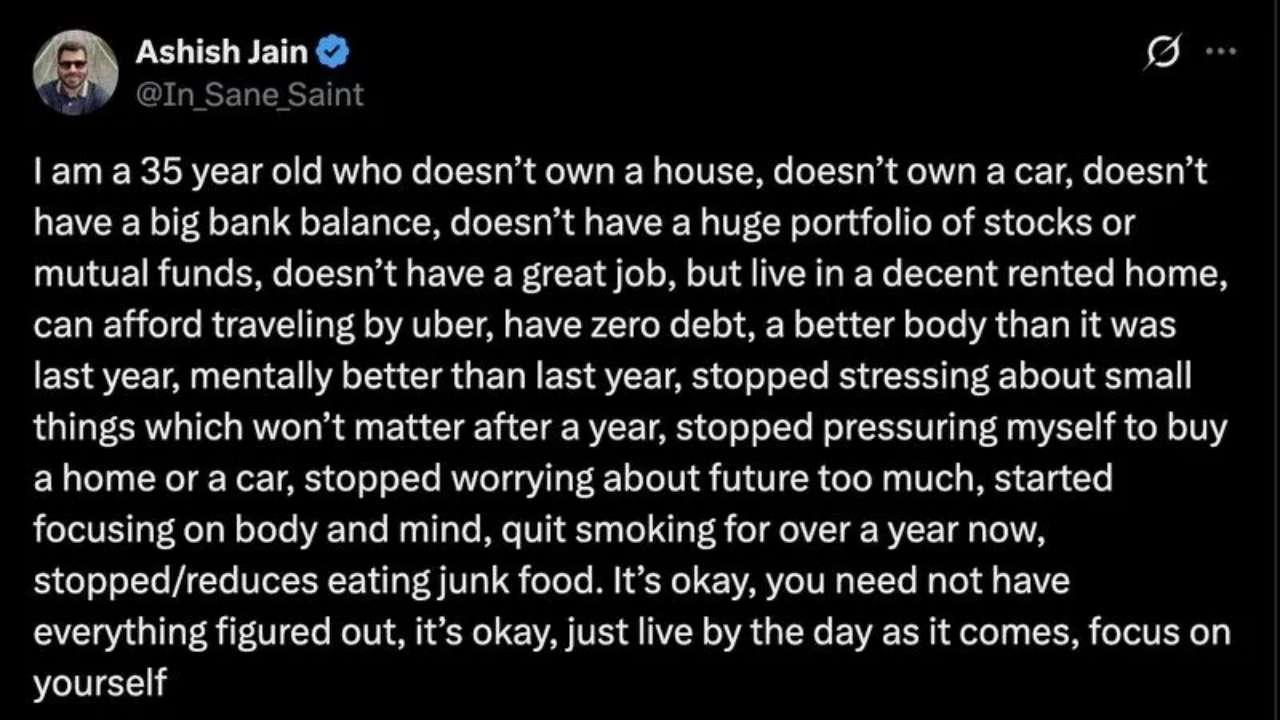
No house. No car. No stock portfolio worth mentioning. No, in his own words, great job.
A 35-year-old wrote that about himself this week and added that he rents a decent home, can afford to travel by Uber, has zero debt, quit smoking, and feels better in his body and mind than he did a year ago. Eighty-three thousand people watched it happen. Most of them called it wisdom.
The easy read is that this is India’s version of lying flat—the Chinese phrase for a generation quietly refusing to compete for property, marriage, and status, choosing stillness over the treadmill. It has been called a counterculture, a rebellion, and a low-desire life. It has spread far enough that people here have started asking whether tang ping India is a real, arriving phenomenon or just a convenient label borrowed for something quieter and more local.
I don’t think that’s quite what this is, and the distinction matters more than it looks like it does.
Lying flat, in its actual, documented form, is a refusal. It says, “I see the race, I understand what winning would require, and I am choosing not to run it.” The posture is defiant even when it looks passive. It is built on a clear-eyed rejection of something fully understood.
What the 35-year-old described is different and quieter than a refusal. He never described a race he saw and declined. He described a life he is already living and reported, honestly by every appearance, that it feels fine. There’s no defiance in his words at all, no mention of a system he’s rejecting, no anger at the housing market or the promotion track. Just an inventory of absences, followed by a report of genuine, current well-being.
That’s not lying flat. Lying flat requires having stood up first, seen the room, and decided to sit back down. This is something that hasn’t been tested against the alternative at all, because the alternative was never actually on the table.
Why “Lying Flat” Doesn’t Quite Fit What He’s Describing
Here is the asymmetry I keep turning over, because I think it’s the actual subject of this essay, more than the tweet itself.
Every version of this question I’ve sat with in years of this work has involved someone who climbed first. A friend who built fifteen properties and still can’t stop. A man who hit his number and went back to work the following Monday. A woman who drew her exit at 45, tested it against the life she’d actually built, and found the two matched. Whatever they eventually chose, more or enough, carries a kind of proof that the 35-year-old’s post cannot carry yet. They know what more felt like, specifically, in their own hands, and they rejected it or embraced it with real information behind the decision.
He has no equivalent test available to him. He can report, honestly, that he feels fine without the house and the car. What he cannot yet know, what nobody in his position can know, is whether that peace would survive contact with the thing he’s describing an absence of. Untested contentment isn’t fake. It just carries a question mark that tested contentment doesn’t, and the question mark isn’t going away just because the post got eighty-three thousand views telling him it’s wisdom.
I mentor early-stage founders through a program I’ve done for years, and I watched a version of this play out in a young man I’ll call Kabir.
Kabir was twenty-six, running a small, sustainable services business out of a shared office in Pune, and completely sincere every time he said money wasn’t the point for him. He wanted something small he could run well, control fully, and be proud of. He said it the way people say things they’ve genuinely decided, not performed—no defensiveness in it, no need to convince me. I believed him. I still think he meant every word.
Then a modest acquisition offer came in, not life-changing by Silicon Valley standards but real, the kind of number that would have let him buy the flat his parents had been quietly hoping he’d buy, the kind of number he’d have called absurd wealth two years earlier, back when the business was three people and a shared desk.
I watched three weeks of him negotiating with himself in real time, not with the acquirer. He stopped returning calls as quickly. He brought it up unprompted on calls that had nothing to do with it. He asked me, almost sheepishly, whether wanting to at least hear the full offer meant he’d been lying to himself the whole time. He hadn’t been. He just hadn’t been tested yet, and the testing itself was visibly uncomfortable in a way his original, sincere answer had never needed to be.
He didn’t take the deal, in the end. But the version of Kabir who turned it down was visibly different from the version who’d told me, a year earlier, that money wasn’t the point. That first Kabir had never had a real number in front of him. The second one had, and his eventual “no” was worth infinitely more than the first one’s, because it had finally been tested against something real.
I think about that difference constantly when I read something like this week’s post. Kabir’s contentment became provable the moment there was something concrete to refuse. The 35-year-old hasn’t had that moment yet, and there is no way to manufacture one for him. It either arrives on its own or it doesn’t, and until it does, the peace he’s describing is real but still, honestly, unconfirmed, even to himself.
There is a test worth running here, though it is a slightly frightening one, which is probably why almost nobody runs it voluntarily.
If the house, the car, and the fuller portfolio were offered tomorrow, at zero social cost either way—nobody watching, nobody judging the choice in either direction—would you take them?
Notice how carefully that question has to be built to actually work. It can’t be “Would you want more money?” because almost everyone’s honest answer to that is yes, and it tells you nothing — wanting more is nearly universal and mostly irrelevant. It can’t be asked in public either, because a public answer contaminates itself immediately; saying no in front of people who already admire your simplicity is a different act entirely from actually declining in private. The zero-social-cost condition is the whole point. It’s the only version of the question that isn’t also, quietly, another performance.
This is a harder question than it sounds, because it risks an answer nobody wants: yes. And if the honest answer is yes, that doesn’t make the original post dishonest. It means the contentment being described is still, at least in part, an accommodation to circumstance rather than a fully examined choice—which is an entirely human, forgivable place to be, and also a different place than the post’s eighty-three thousand admirers assumed he was standing in.
If the honest answer is no, if he’d genuinely leave the offer on the table with no one watching either way, then something real is happening here, and it deserves to be taken exactly as seriously as it’s being taken online, not because it resembles lying flat, but because it’s rarer and harder than that: peace assembled before proof, holding up anyway.
I don’t know which answer is true for him, and neither, I suspect, does he, not yet, and maybe not for years, since the offer he’d need to actually test it may never arrive at all. That absence of a test is not a flaw in his post. It’s just the honest, unfinished shape of what he’s actually describing, whether the eighty-three thousand people who called it wisdom noticed that or not.
I want to be careful not to make this sound like an argument that the 35-year-old is wrong, or performing, or fooling himself. I don’t think that, and I don’t think it’s my place, or anyone’s, to diagnose a stranger’s post from a screen.
I also want to resist the opposite mistake, which is treating “untested” as a polite word for “lesser.” There is a real, honest case that choosing to opt out of the wealth race before it fully claims you is its own kind of achievement, arguably a harder one than opting out after. Kabir had years of watching other people’s businesses fail and succeed around him before his own test arrived. The 35-year-old may have been building his version of clarity just as deliberately and quietly, without a single dramatic offer ever needing to appear, some people manage to see the race clearly enough, early enough, from the outside, that they never feel compelled to enter it at all. That is not automatically a lesser form of knowing than learning it the hard way, at the finish line, the way Vishal and dozens of others I’ve sat with eventually did.
What I don’t think holds up is calling it lying flat or treating either version, tested or untested, as more virtuous than the other by default. Both are just different distances from the same open question, and the honest thing to do with either one is keep checking, not stop at the first version that sounds peaceful enough to post.
What I think is worth saying plainly is this: peace chosen after you’ve climbed is easier for other people and for yourself to trust, because it comes with a receipt. Peace assembled before you’ve ever had the chance to climb doesn’t come with one yet, and pretending otherwise, either to reassure yourself or to reassure eighty-three thousand strangers, skips over the one honest thing worth sitting with. Not “is this wisdom or self-deception.” Just: Has this actually been tested yet, and if not, am I willing to find out what happens when it is?
Tang ping India is a phrase some commentators have already started reaching for to describe this. If it’s accurate, it will mostly look like this: quiet, undramatic, and closer to acceptance than rebellion in people who never got close enough to the race to need to refuse it. That’s not a lesser version of the Chinese movement. It’s a genuinely different psychological position, and it deserves its own honest name rather than borrowing someone else’s.