He Had the Math for Retirement. He Didn’t Have a Tuesday.
₹3.5 crore, modeled three different ways. All three held up.
He had no model at all for Tuesday.
Most people asking what to do after retirement start with the money, because the money has an answer you can check against a spreadsheet. S. had done that part properly: mutual funds, fixed deposits, a flat he could sell or rent, and two decades of a disciplined SIP he was visibly proud of. I didn’t have much to add to the math. It was fine.
I’ll call him S. I don’t know his real name and wouldn’t use it if I did, but I’ve sat across from enough versions of him, at Viram and on clarity calls, that the shape of this conversation was familiar before it started.
S. is 44, a finance executive in Mumbai. He opened with the number, wanting to know if I agreed with it. What I noticed instead was the word he used for what came after it.
What to Do After Retirement Isn’t a Financial Question
“I just want some peace,” he wrote. “I want to step back.”
Peace. Step back. I hear some version of this in nearly every early conversation with someone weighing whether to stop working, and I’ve learned to treat it as a flag rather than an answer, because it almost never survives one follow-up question.
I asked S. what a normal Tuesday would look like, six months after he’d actually stopped.
He said he wanted to relax, spend time with family, and maybe travel more. Nothing wrong with any of it. But none of it was a Tuesday. Relax isn’t a place you wake up in. Spending time with family doesn’t tell you what you’re doing at eleven in the morning once your wife is at work, your kids are at school, and the house is quiet in a way it has never once been quiet before.
Here’s what I’ve come to believe, after enough of these conversations: words like “peace,” “balance,” and “stepping back” aren’t descriptions of a life. They’re placeholders for one. They feel like answers because they’re the opposite of what the person is currently living: pressured, over-scheduled, and accountable to other people’s calendars all day. But the opposite of a bad thing isn’t a plan. It’s relief, and relief runs out by lunchtime on the first free Tuesday.
S. had spent months building the financial model. He had spent no time on the actual day. That’s not a criticism of him specifically—it’s close to universal among the senior professionals I meet. The number gets treated as the hard problem because it has an answer you can check. What to do after retirement gets treated as something that will sort itself out, because nobody ever taught anyone to plan a day the way they were taught to plan a portfolio.
I asked him again, more specifically. Not “what do you want” — that question is too big, and people answer it in slogans. I asked what he’d actually be doing between nine and one on a random Tuesday, assuming money wasn’t the constraint.
The first answer was still vague. Reading more, maybe some travel, catching up with old friends.
I pushed once more. What time would he wake up? What would the first hour actually contain? Who, specifically, would he see that day?
That’s when something shifted. He wrote back a few hours later with an actual morning: up by six-thirty, a walk before the city got loud, and breakfast with his father, who lives two floors below him and whom he currently sees maybe twice a month despite the proximity. Two hours in the late morning were spent relearning the guitar, something he’d started and abandoned three separate times since college. Lunch.
An afternoon he admitted was still mostly open—he didn’t know yet what filled it and said so plainly, which is more than most people manage. Evenings with his wife, most nights, instead of the two or three he currently gets. One real trip a year instead of the truncated four-day version he takes now, jet-lagged for two of them.
It wasn’t a finished plan. Parts of it stayed fuzzy, and he knew it. But it was the first time in the whole conversation he’d described a life instead of an escape from one. The distance between “I want peace” and “I want breakfast with my father twice a week” is the entire distance between a wish and a plan. One of those you can actually build toward. The other one just sits there sounding correct, doing nothing.
Here’s where it got honest, and I want to be careful not to make this sound tidier than it was.
A week later, S. wrote back. He’d decided to work two more years. Not because ₹3.5 crore failed his own math—it didn’t, by his own model, comfortably. He wanted one more crore. For protection, he said. A cushion against a market downturn, a medical emergency, or his children’s education costing more than planned.
I want to be fair to him here, the way I try to be fair to everyone who does this. None of those risks are imaginary. A correction is real. Healthcare costs in this country are real and rising. This wasn’t an unreasonable instinct dressed up as a reasonable one.
But I’d also just watched him build, for the first time, an actual picture of the Tuesday he said he wanted. And within a week of finally having it, he’d found a reason to delay living it by two years.
I asked him directly whether this was genuine prudence or the number moving again, the way it tends to once the real question gets close. He didn’t have a clean answer, and to his credit, he didn’t pretend to. Probably some of both, he said.
I believe him. I think it usually is some of both. The honest version of this isn’t “everyone who delays is avoiding something.” It’s narrower and harder to argue with: the closer someone gets to an actual, specific Tuesday, the more the old, vague number starts to feel safer than the new, specific life. A bigger number is familiar. A father you see twice a week instead of twice a month is not, even when it’s exactly what you said you wanted three sentences earlier.
I told S. something I’ve come to believe applies to almost everyone in his position, whether the number is two years away or ten. If retirement planning India conversations only start once someone is ready to stop working, they’ve started far too late; the actual planning, the kind that determines whether the retirement is any good, has to happen years before the money side is even close to settled. Most retirement planning India content treats this as a financial exercise from start to finish, which is exactly backwards for the part that actually decides whether the eventual number gets used or just becomes the next thing to protect.
So I asked him not to wait for the extra crore before touching any of it. If breakfast with his father twice a week was genuinely part of the Tuesday he wanted, that didn’t require retirement; it required walking downstairs one Saturday and starting. If the guitar mattered, buying one this month and finding out, honestly, whether two hours a day of it still held his attention past the first fortnight was more useful than another two years of assuming it would. A plan that has never been tested in any form is built entirely out of imagination, and imagination is a poor judge of what actually holds a person’s attention for a decade.
He pushed back gently on one part of this, and I think he was right to. The number he’d added, he said, wasn’t only about the guitar and the breakfasts, some of it was a genuine hedge against real risk, the kind that has nothing to do with avoidance. I told him that was fair and worth separating out plainly for himself: one part of that extra crore was protecting him from an actual, nameable danger.
Another part, he admitted after a pause, was protecting him from an unplanned afternoon, dressed up in the language of prudence so it wouldn’t have to answer to itself. Both were real. They just weren’t the same thing, and conflating them was making the whole decision harder to see clearly than it needed to be.
The identity question worried me more than the schedule did, if I’m honest. For twenty years, S.’s job had quietly been doing double duty, it paid the bills, and it also answered who he was at a dinner party, in his family’s WhatsApp group, and in his own head at six in the morning before the day started. Two more years wouldn’t fix that. It would just postpone the moment he’d have to find out whether anything else in his life could hold that kind of weight, and postponing it doesn’t make the eventual answer easier — it just moves the deadline.
The same was true of his health. He’d said, more than once, that he’d finally start walking properly and get his checkups current “once things calm down.” I’ve heard that sentence from almost everyone I’ve had this exact conversation with, and it is almost never true on its own. The structure a job provides, a reason to get up, and somewhere to be were quietly doing some of that discipline for him too, and it doesn’t transfer automatically to unstructured time just because the time finally arrives.
I don’t know if S. will retire in two years, or four, or later still, and it isn’t mine to decide for him. What I’d gently push back on is the idea, which I hear constantly, that the number is the thing standing between someone and the life they say they want. In my experience it’s almost never the number. It’s the absence of a Tuesday specific enough to be worth choosing over the safety of postponing it.
The people I’ve watched figure out what to do after retirement well, not perfectly, but well, are rarely the ones with the biggest cushion. They’re the ones who could describe, in real detail, what they were retiring into, long before they had the money to afford it. The number, when it finally arrived, wasn’t the decision. It was just the formality that let them start doing what they’d already designed.
He’s Not Lying Flat. He Never Stood Up First.
No house. No car. No stock portfolio worth mentioning. No, in his own words, great job.
A 35-year-old wrote that about himself this week and added that he rents a decent home, can afford to travel by Uber, has zero debt, quit smoking, and feels better in his body and mind than he did a year ago. Eighty-three thousand people watched it happen. Most of them called it wisdom.
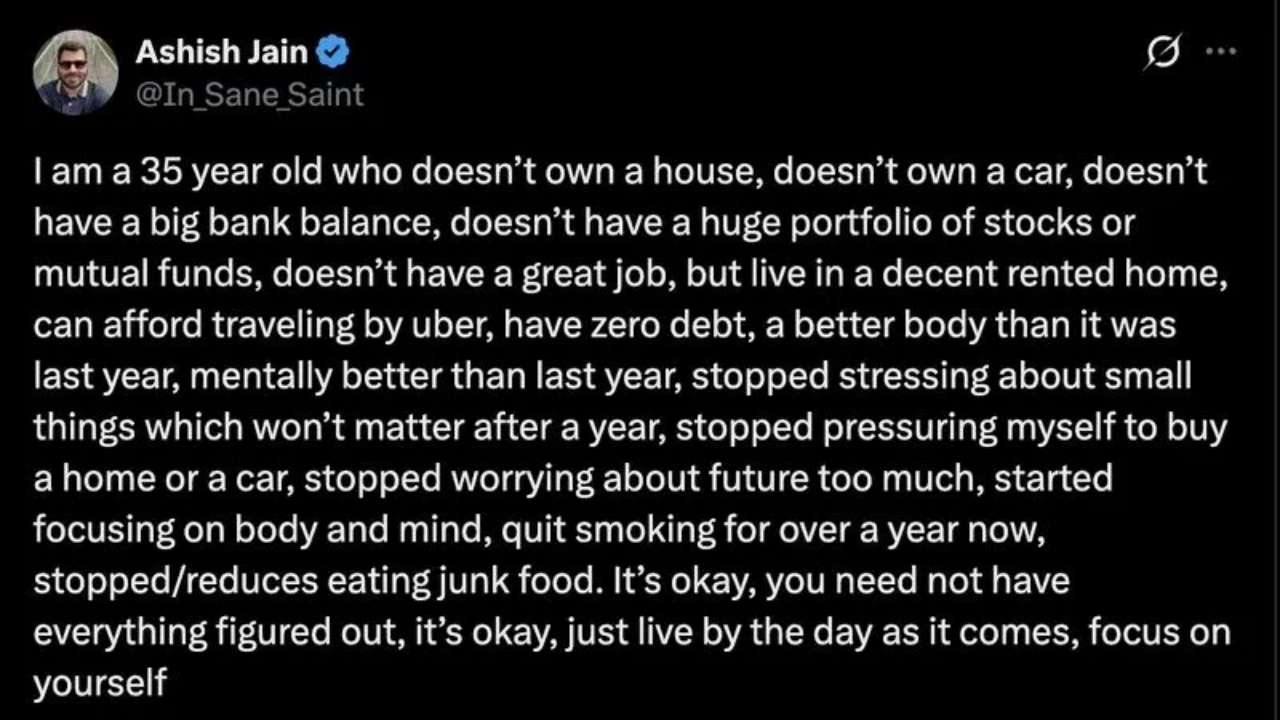
The easy read is that this is India’s version of lying flat—the Chinese phrase for a generation quietly refusing to compete for property, marriage, and status, choosing stillness over the treadmill. It has been called a counterculture, a rebellion, and a low-desire life. It has spread far enough that people here have started asking whether tang ping India is a real, arriving phenomenon or just a convenient label borrowed for something quieter and more local.
I don’t think that’s quite what this is, and the distinction matters more than it looks like it does.
Lying flat, in its actual, documented form, is a refusal. It says, “I see the race, I understand what winning would require, and I am choosing not to run it.” The posture is defiant even when it looks passive. It is built on a clear-eyed rejection of something fully understood.
What the 35-year-old described is different and quieter than a refusal. He never described a race he saw and declined. He described a life he is already living and reported, honestly by every appearance, that it feels fine. There’s no defiance in his words at all, no mention of a system he’s rejecting, no anger at the housing market or the promotion track. Just an inventory of absences, followed by a report of genuine, current well-being.
That’s not lying flat. Lying flat requires having stood up first, seen the room, and decided to sit back down. This is something that hasn’t been tested against the alternative at all, because the alternative was never actually on the table.
Why “Lying Flat” Doesn’t Quite Fit What He’s Describing
Here is the asymmetry I keep turning over, because I think it’s the actual subject of this essay, more than the tweet itself.
Every version of this question I’ve sat with in years of this work has involved someone who climbed first. A friend who built fifteen properties and still can’t stop. A man who hit his number and went back to work the following Monday. A woman who drew her exit at 45, tested it against the life she’d actually built, and found the two matched. Whatever they eventually chose, more or enough, carries a kind of proof that the 35-year-old’s post cannot carry yet. They know what more felt like, specifically, in their own hands, and they rejected it or embraced it with real information behind the decision.
He has no equivalent test available to him. He can report, honestly, that he feels fine without the house and the car. What he cannot yet know, what nobody in his position can know, is whether that peace would survive contact with the thing he’s describing an absence of. Untested contentment isn’t fake. It just carries a question mark that tested contentment doesn’t, and the question mark isn’t going away just because the post got eighty-three thousand views telling him it’s wisdom.
I mentor early-stage founders through a program I’ve done for years, and I watched a version of this play out in a young man I’ll call Kabir.
Kabir was twenty-six, running a small, sustainable services business out of a shared office in Pune, and completely sincere every time he said money wasn’t the point for him. He wanted something small he could run well, control fully, and be proud of. He said it the way people say things they’ve genuinely decided, not performed—no defensiveness in it, no need to convince me. I believed him. I still think he meant every word.
Then a modest acquisition offer came in, not life-changing by Silicon Valley standards but real, the kind of number that would have let him buy the flat his parents had been quietly hoping he’d buy, the kind of number he’d have called absurd wealth two years earlier, back when the business was three people and a shared desk.
I watched three weeks of him negotiating with himself in real time, not with the acquirer. He stopped returning calls as quickly. He brought it up unprompted on calls that had nothing to do with it. He asked me, almost sheepishly, whether wanting to at least hear the full offer meant he’d been lying to himself the whole time. He hadn’t been. He just hadn’t been tested yet, and the testing itself was visibly uncomfortable in a way his original, sincere answer had never needed to be.
He didn’t take the deal, in the end. But the version of Kabir who turned it down was visibly different from the version who’d told me, a year earlier, that money wasn’t the point. That first Kabir had never had a real number in front of him. The second one had, and his eventual “no” was worth infinitely more than the first one’s, because it had finally been tested against something real.
I think about that difference constantly when I read something like this week’s post. Kabir’s contentment became provable the moment there was something concrete to refuse. The 35-year-old hasn’t had that moment yet, and there is no way to manufacture one for him. It either arrives on its own or it doesn’t, and until it does, the peace he’s describing is real but still, honestly, unconfirmed, even to himself.
There is a test worth running here, though it is a slightly frightening one, which is probably why almost nobody runs it voluntarily.
If the house, the car, and the fuller portfolio were offered tomorrow, at zero social cost either way—nobody watching, nobody judging the choice in either direction—would you take them?
Notice how carefully that question has to be built to actually work. It can’t be “Would you want more money?” because almost everyone’s honest answer to that is yes, and it tells you nothing — wanting more is nearly universal and mostly irrelevant. It can’t be asked in public either, because a public answer contaminates itself immediately; saying no in front of people who already admire your simplicity is a different act entirely from actually declining in private. The zero-social-cost condition is the whole point. It’s the only version of the question that isn’t also, quietly, another performance.
This is a harder question than it sounds, because it risks an answer nobody wants: yes. And if the honest answer is yes, that doesn’t make the original post dishonest. It means the contentment being described is still, at least in part, an accommodation to circumstance rather than a fully examined choice—which is an entirely human, forgivable place to be, and also a different place than the post’s eighty-three thousand admirers assumed he was standing in.
If the honest answer is no, if he’d genuinely leave the offer on the table with no one watching either way, then something real is happening here, and it deserves to be taken exactly as seriously as it’s being taken online, not because it resembles lying flat, but because it’s rarer and harder than that: peace assembled before proof, holding up anyway.
I don’t know which answer is true for him, and neither, I suspect, does he, not yet, and maybe not for years, since the offer he’d need to actually test it may never arrive at all. That absence of a test is not a flaw in his post. It’s just the honest, unfinished shape of what he’s actually describing, whether the eighty-three thousand people who called it wisdom noticed that or not.
I want to be careful not to make this sound like an argument that the 35-year-old is wrong, or performing, or fooling himself. I don’t think that, and I don’t think it’s my place, or anyone’s, to diagnose a stranger’s post from a screen.
I also want to resist the opposite mistake, which is treating “untested” as a polite word for “lesser.” There is a real, honest case that choosing to opt out of the wealth race before it fully claims you is its own kind of achievement, arguably a harder one than opting out after. Kabir had years of watching other people’s businesses fail and succeed around him before his own test arrived. The 35-year-old may have been building his version of clarity just as deliberately and quietly, without a single dramatic offer ever needing to appear, some people manage to see the race clearly enough, early enough, from the outside, that they never feel compelled to enter it at all. That is not automatically a lesser form of knowing than learning it the hard way, at the finish line, the way Vishal and dozens of others I’ve sat with eventually did.
What I don’t think holds up is calling it lying flat or treating either version, tested or untested, as more virtuous than the other by default. Both are just different distances from the same open question, and the honest thing to do with either one is keep checking, not stop at the first version that sounds peaceful enough to post.
What I think is worth saying plainly is this: peace chosen after you’ve climbed is easier for other people and for yourself to trust, because it comes with a receipt. Peace assembled before you’ve ever had the chance to climb doesn’t come with one yet, and pretending otherwise, either to reassure yourself or to reassure eighty-three thousand strangers, skips over the one honest thing worth sitting with. Not “is this wisdom or self-deception.” Just: Has this actually been tested yet, and if not, am I willing to find out what happens when it is?
Tang ping India is a phrase some commentators have already started reaching for to describe this. If it’s accurate, it will mostly look like this: quiet, undramatic, and closer to acceptance than rebellion in people who never got close enough to the race to need to refuse it. That’s not a lesser version of the Chinese movement. It’s a genuinely different psychological position, and it deserves its own honest name rather than borrowing someone else’s.
Even Your Exhaustion Is Being Watched
Three reels landed in one feed, in one week.
Before I understood what connected them, I only knew they were describing something close to performative vulnerability, though none of the three used that phrase.
One argued, in Hindi, that Indian society rewards looking successful over being okay. The man drowning quietly inside a Mercedes; the eighty-hour job that costs someone their sleep and health earns more respect than a small job that actually makes them happy. Taali ya neend, it said. Applause or sleep. Choose.
Another was quieter. No thesis, no argument, just a confession, written carefully, about an exhaustion that doesn’t lift no matter how much sleep you get. No anger at anyone specific. Just a wish to be somewhere nobody expects anything.
A third made the same case in English — that an entire generation has quietly redefined success from having more to needing less.
Three pieces of content. One message. One week. That stopped being a coincidence somewhere around the second one.
I want to start with the part that took me longer to see than I’d like to admit, because I think it’s the actual essay, not the throat-clearing before it.
That second reel, the quiet one, the tired one, the one with no thesis, is also, by definition, a performance. It was written with care. It was paced for resonance. It landed the way it landed because someone, consciously or not, built it to land.
Which means the exact thing the first reel was criticizing—dikhawa, performing over being—has slipped quietly into the piece that claims to be about opting out of performing altogether.
Even the exhaustion is getting produced now. Even wanting to disappear has become something you write a caption for.
This is what I mean by performative vulnerability. Not fake feeling The tiredness in that second reel may be completely real. Performative vulnerability is what happens when a real feeling gets shaped, timed, and released for an audience before it’s been allowed to simply exist for the person having it.
I watched a version of this happen in person, at Viram, and I think about it more than almost anything else from that particular cohort.
I’ll call her Ira. On our first call, before she’d arrived, she used almost the exact language from that second reel. Tired in a way sleep doesn’t fix. Not angry at anyone. Just wanting a few days where nobody needed anything from her. It was, word for word, one of the more articulate descriptions of exhaustion I’d heard in years of doing this work.
On day two, we gave her exactly what she’d asked for. An entire afternoon, alone, on the property; no schedule, no expectation, nobody watching.
She lasted about forty minutes.
I watched her leave for the trail with a book she never opened. When she came back, her phone was in her hand, not her book. Not because the exhaustion wasn’t real; I don’t doubt for a second that it was. But because real, unwitnessed rest turned out to be an entirely different experience than the idea of rest she’d been describing so precisely on our call. Without anyone to receive the performance of needing space, needing space stopped having shape. It had nowhere to land. Forty minutes in, she told me later, she’d caught herself composing a sentence in her head, something about the mountains, the silence, and finally breathing, for an audience that, in that moment, did not exist and was not going to see it.
She came back early, quieter than before, and admitted — this is the part I think about — that she’d spent most of the forty minutes deciding how she’d describe the afternoon to people back home, rather than actually having the afternoon. The rest she’d been aching for turned out to require an audience she hadn’t realized she needed until the audience was gone.
She’d asked for solitude and instinctively started narrating it before she’d finished living it.
I don’t think Ira is unusual. I think Ira is what happens to almost anyone who has spent long enough being rewarded for how things look that they’ve lost the muscle for an experience that nobody will ever know about.
The first reel’s argument is really about this same muscle, just applied more broadly, and I’ve watched its exact examples play out for twenty-two years from inside corporate HR.
The gym photo before the gym membership itself. The housewarming party before the house is actually settled into. The anniversary post before the relationship itself has been tended to in the ways that don’t photograph well.
I have sat in more performance reviews than I can count where the person visibly straining under an unsustainable workload said nothing because saying it aloud read as weakness, while the person who’d quietly built a sane, sustainable pace got asked, gently and disapprovingly, whether they were ambitious enough. I have watched people take the eighty-hour job specifically because the exhaustion it produced was legible—nameable, complainable-about at dinner, and worn like a badge—while a genuinely peaceful, smaller life got treated by the same room as a story that needed explaining. Are you okay? People would ask about the person who actually was.
I remember one resignation letter, years ago, from a man who had never once complained in three years on my team. Two lines. Thank you for the opportunity. I’ve decided to spend more time with my daughter before she’s no longer a child who wants me around. No exhaustion story. No dramatic exit. He had simply, quietly, decided, and left. In the same quarter, another employee whose burnout had been the subject of at least four separate conversations, three group emails of concern, and one all-hands mention of “protecting our “people”—stayed for another two years, still complaining, still performing the exhaustion for an audience that had by then stopped really listening. I don’t know, to this day, which of them was actually more tired. I only know which one made it visible and which one simply acted on it without asking anyone to watch.
Dikhawa culture India runs on precisely this confusion. It doesn’t just reward success. It rewards the version of success — and lately, I think, the version of struggle — that comes with a built-in audience already positioned to notice it.
None of this starts in adulthood, and the reel that opened this essay was right to point at where it actually begins.
We are taught marks before we are taught meaning. Trophies before contentment. Perform in front of the relatives, sit up straight for the photo, and don’t let them see you cry at the funeral; smile for the group picture even in the year everything fell apart. Log kya kahenge (what will people say) is not a stray anxiety that shows up occasionally in adult life. For a lot of us, it was installed early enough and repeated often enough that it stopped feeling like a rule and started feeling like conscience.
By the time any of us are old enough to decide, on our own, whether a feeling is worth having privately or worth sharing publicly, the machinery for deciding that has usually already been built by other people, for other reasons, years before we noticed it happening. We were never taught to simply be. We were taught, carefully and repeatedly, to be seen. It is not a surprise, given that training, that even the generation now naming its exhaustion out loud is naming it the way it was taught to name everything else—visibly, articulately, and for an audience that is expected to respond.
What Performative Vulnerability Actually Costs the Person Doing It
Here is the part of all three reels that none of them said, and I think it’s the part that matters most.
The person who is winning this particular game is also losing it. The reel got this right. The man in the Mercedes, the woman with the picture-perfect anniversary post over a marriage that’s quietly dying—they are not exempt from emptiness. If anything, they are further from resolving it, because the applause keeps arriving on schedule, telling them the performance is working, even while the thing underneath it goes on unaddressed.
What none of the three reels named is that the exhaustion post can do the exact same thing. It can become its own small, sad Mercedes—a place to receive real comfort, real comments, and real evidence that you are seen and understood, which quietly makes it a little bit less urgent to change the actual life producing the exhaustion. The relief of being witnessed in your tiredness is real. It is also, if you’re honest, sometimes enough relief to make you stop looking for the harder, quieter, unwitnessed relief that would have actually addressed the tiredness itself.
I don’t say this to make anyone’s exhaustion suspect. Most of it is completely real, including Ira’s, including whoever wrote that second reel. I say it because “real” and “performed” are not opposites. They can be true of the exact same feeling at the exact same time, and learning to tell which parts of your own experience are which might be the most useful, least comfortable thing you ever do for yourself.
So here is the test I’d actually offer, since the reel that started this ended with one too.
Not “are you tired.” Almost everyone reading this is tired. Not even “is it real.” It’s real. That was never the question.
The question is this: would you still want the rest, the quiet, and the disappearing if you were completely certain nobody would ever find out you’d taken them? No caption, no story, no one asking if you’re okay, no comment thread offering you comfort for having said the brave, tired thing out loud. Just you and the actual hours, unwitnessed forever.
If the answer is yes — if the wanting survives completely intact once you remove every single person who might have seen it — then what you have is not performance. It’s the real thing, and it deserves to be protected exactly as fiercely as Ira’s exhaustion deserved protecting, even though she couldn’t yet give it to herself.
If the answer gets quieter, if some of the wanting seems to evaporate the moment nobody would ever know, that’s not a character flaw. It’s just information. It means part of what you’ve been calling rest was actually still a performance of rest, aimed at an audience you didn’t fully realize you were still performing for.
Taali ya neend. The reel that started all this got the choice exactly right. I’d only add, “Check honestly which one you’re actually choosing before you assume the answer.”
Most people never run this test on themselves, not because they’re shallow, but because nobody ever taught them how, and because the answer, when it’s honest, is sometimes uncomfortable enough that it’s easier not to look. Dikhawa culture India doesn’t reward the people who look, only the people who perform having already looked.
This is, plainly, the work I do. Not therapy, not a wellness retreat, not another feed to perform tiredness into. A structured, private space, built specifically as an antidote to performative vulnerability rather than another outlet for it—the kind Ira eventually found on day three, once the performance had nowhere left to go and the actual feeling finally had room to exist—where the only audience for what you’re carrying is you and, briefly, someone whose entire job is to ask the harder version of the question you’ve been asking yourself in captions.
If any part of this essay landed somewhere you didn’t expect it to—if you noticed yourself checking, honestly, which parts of your own tiredness are real and which parts are waiting for someone to notice—the Clarity Call is free, thirty minutes, no pitch, and nobody will ever know you booked it except you. That, it turns out, is usually the entire point.
Needing Less Isn’t Wisdom. Unless You Chose It.
A reel crossed my feed this week making a claim I’ve been watching happen for years; I’ve just never heard it framed this precisely.
Success used to mean having more. For a lot of people now, it means needing less.
What she was describing, without using the phrase, is what’s now being called “quiet ambition,” and quiet ambition splits cleanly into two very different things, depending on how someone actually got there.
The woman making the argument was honest about where her own thinking ran out. Every conversation with people her age sounds the same now, she said. I just want a job that doesn’t make me miserable. I want to sleep properly. I want time with my friends and with my parents. I want enough money to not be stressed. That’s it.
She didn’t call this laziness. She called it fifteen years of watching the goalposts move—study hard, get the grades, get into the good college, get the good job, get the promotion, and then what? The housing prices are insane. The promotion made you more stressed, not less. Maybe millennials are the first generation to realize there is no finish line, she said.
Then she stopped, honestly, at the hardest part.
“Maybe that’s wisdom,” she said. Or maybe we’re all just worn out. I genuinely don’t know.
I think I do know. Because I’ve sat across from both versions of the person she’s describing, and from the outside they are almost impossible to tell apart.
Both of them will tell you, in nearly identical words, that they’ve stopped chasing. Both will describe wanting less, needing less, and running less. Both will use the word peace. If you only listened to what they said, you would conclude they’d arrived at the same place by the same road.
They have not.
One of them drew a picture.
Not metaphorically. I mean an actual picture, on an actual page, years before they had the means to live inside it—what a Tuesday would look like, specifically, hour by hour, once the running stopped. Who they’d be with. What work, if any, they’d still choose to do. What the quiet actually felt like, in detail, not as an abstraction. When the running did eventually stop, for this person, the picture and the life matched. Not approximately. Precisely, the way a plan matches an outcome when the plan was real.
This person’s “needing less” is not a retreat. It is possibly the single most deliberate decision they have ever made, dressed in language so quiet it sounds like giving up.
The other person never drew anything.
They simply got tired enough, for long enough, that wanting less started to feel like the only sane thing left to want. There was no picture. There was no Tuesday they could describe to you in detail, because they’d never sat still long enough to build one. What they have instead is relief: the specific, real, and completely legitimate relief of a nervous system that has finally been allowed to stop bracing. That relief is not nothing. But it is not the same thing as clarity, and mistaking one for the other is exactly how a person ends up, eighteen months later, unexpectedly restless inside a life they swore would finally be peaceful.
The reason these two people sound identical is that the vocabulary of “enough” is genuinely the only vocabulary either of them has access to. Our culture gave both of them the same handful of phrases—balance, boundaries, peace, and enough—and neither the language nor the culture much cares which foundation those words are sitting on. A sentence like “I just want to sleep properly” can be the exhausted end of fifteen years of chasing goalposts, or it can be the calm, specific request of someone who has already built the life where that sentence is simply and literally true. English doesn’t have two different words for those. Neither, as it turns out, does a viral reel with ninety seconds to make its point.
I don’t think this is a millennial problem, particularly, though the reel is right that this generation is unusually loud about naming it. Quiet ambition, real or performed, has probably existed in every generation. This one just says it out loud, on camera, at scale. I think it’s the oldest confusion there is, wearing a very current outfit. Every generation has produced people who called their exhaustion “wisdom” because “wisdom” sounded better, and calling it that made the exhaustion easier to bear. What’s new, maybe, is that an entire cohort is now saying the quiet part out loud, together, at scale, on camera, which makes the confusion easier to see if you’re willing to actually look at it instead of just nodding along because the sentiment feels true.
How to Tell If Your Quiet Ambition Is Real
Here is the test I actually use, with the people who sit across from me making some version of this exact claim.
I ask what a completely free Tuesday looks like. Not the fantasy version — nobody has trouble describing a fantasy. The real one. Where are you? What time did you wake up? What’s the first thing you do that isn’t checking a phone? Who’s around? What, if anything, are you working on, and why that thing specifically?
The people who have actually chosen quiet ambition answer this within seconds, in specific, almost boring detail. They’ve lived inside the answer already, in their heads, hundreds of times, long before they arrived at it in fact. The picture doesn’t need to be invented under pressure. It was already there.
The people who are tired, not wise, go quiet in a different way than the reel’s narrator went quiet. They start reaching for the same abstractions again — peace, balance, less stress — because underneath the abstractions there’s nothing yet. Not because they’re shallow. Because nobody ever asked them to build anything more specific than a feeling to run toward, and a feeling, unlike a Tuesday, doesn’t have any hours in it you can actually check your life against.
This is not their fault. Almost nobody teaches this distinction. We teach ambition in exhaustive detail—the degrees, the ladders, the goalposts, and the reel names so precisely. We teach almost nothing about how to want less on purpose, with the same rigor we were taught to want more.
I want to be careful here, because there’s a version of this essay that turns into telling tired people they haven’t earned their rest until they’ve done more homework first, and that is not what I mean.
Rest is not conditional on having a five-year plan for what comes after it. If you are exhausted, you are allowed to stop, full stop, with no picture required and no test passed first. The distinction I’m making isn’t about who deserves to rest. It’s about what happens after the resting starts to feel normal again, which for most people, eventually, it does.
That’s usually when the second, quieter question shows up, the one the reel’s narrator hasn’t reached yet. Not “am I tired?” Tired resolves, given enough time and enough actual rest. The second question is “What do I actually want now that I’m not too depleted to want anything?” and that one does not resolve on its own. It has to be built, the same slow, deliberate way ambition used to be built, just pointed in a different direction.
Some people build it. Their version of needing less turns out to be exactly as considered, as chosen, and as durable as any five-year career plan ever was—just quieter and aimed at something that doesn’t show up on a resume.
Other people never build it, because the relief of stopping felt so much like an answer that they mistook it for one. They call it peace for a while. Then, often around the point everyone around them stops asking if they’re okay, the old restlessness comes back wearing a new question: Is this actually what I wanted, or is this just where I stopped running?
The culture is finally catching up to something worth saying carefully about quiet ambition instead of just quoting it.
Needing less isn’t automatically wiser than wanting more. It’s only wiser when someone actually chooses it, with open eyes, specific enough to describe an ordinary Tuesday inside it—rather than arriving there because everything else simply got too heavy to keep carrying and staying there because nobody ever asked them the second question.
If you’re not sure yet which one is true for you, that’s not a failure. It’s just information. It means the picture hasn’t been drawn yet, not that something is wrong with you for still wanting to know.
If this stayed with you, the clarity call is free and takes thirty minutes. No pitch. Most people leave it finally able to describe their Tuesday.
He Built a Case for Staying. He Already Wanted to Leave.
Most NRI return to India decisions get argued out on a spreadsheet. This one gave itself away in a single paragraph instead.
A post crossed my feed a few weeks ago. An anonymous handle, a forum for people planning early retirement, the kind of place where net worth gets typed out like a resume.
I do not know this man. I will call him R. But I have sat across from a dozen versions of him in Dehradun, so the words could have come from any of them.
Here is roughly what he wrote.
He and his wife live in California. Forty-two and forty, one son, ten years old. They can retire now, in India, at a level of wealth that would be considered fat in any city in the country. Or they can wait eight more years, keep working in the Bay Area, and retire there instead, at a number that is objectively larger in dollar terms.
He wrote that he has “a quiet ache for home.” He asked how other people in his position make the decision. What is the thought process? How do you let go?
Then, a few lines later, without seeming to notice he had done it, he answered his own question.
He wrote that human migration is normal. That moving is not leaving your roots behind; it is spreading them. That Europeans, when they ran out of space, spread themselves to new worlds, and future generations enjoyed what they built. He told himself he should not feel guilty. Future generations, he said, will enjoy the space they have here.
I read that paragraph three times.
The question that was already answered
R. thinks he is asking a financial question. Forty crore now versus four million dollars in eight years, both numbers in a very high cost of living area, and both numbers are comfortable by any measure. He is asking the forum to help him do the math.
But nobody builds a defense for a decision they haven’t made.
You do not construct an argument about the nobility of migration, complete with a historical precedent about Europeans settling new continents, if you are genuinely deciding between two acceptable outcomes. You construct that argument because some part of you has already chosen, and the rest of you needs permission to admit it.
I have watched this pattern enough times to recognize it instantly. It rarely announces itself as indecision. It shows up as research. As a spreadsheet with one more column added. As a forum post asking strangers for a “thought process,” when the real question is much smaller and much harder: Is it acceptable for me to want what I already want?
R. wants to go home. He said so in the first sentence. Everything after that first sentence is scaffolding, built to hold up a decision that does not actually need defending, only permission.
Why the defense had to be so elaborate
I want to be fair to him, because I understand exactly why the case had to be this big.
He is not choosing between two neutral options. He is choosing to walk away from a number that keeps growing, in a system that has told him, at every stage of his career, that the correct move is always the one that produces a bigger number. Silicon Valley does not have a category for “enough.” It has levels, refresh cycles, and the next vest date. A person who has spent years inside that machine does not leave it quietly. They leave it with an argument prepared, because some part of their nervous system still expects to be cross-examined.
So the argument becomes big. It becomes historical. It reaches all the way back to European settlers, because a decision that only concerns one family’s happiness apparently is not weighty enough to justify walking away from a fatter number. It needs the added gravity of destiny, of generations, of an old and larger story that has nothing to do with a ten-year-old boy who misses his grandparents.
This is what guilt does when it is unspoken. It does not stay small. It recruits history to make its case.
I do not think R. is unusually anxious or unusually indecisive. This is what an NRI return to India decision looks like for a lot of high-earning professionals who grew up in a culture that ties self-worth tightly to output. He has internalized, probably without ever choosing to, that wanting to go home for reasons that are simply emotional is not a strong enough reason. So the ache becomes a thesis. The homesickness becomes an essay about migration patterns.
What eight years actually costs
Here is the part of the calculation that a spreadsheet cannot hold and that I think matters more than either number he is comparing.
His son is ten.
In eight years, his son will be eighteen. Not a child who wants his father around for the texture of ordinary days—school pickups, weekend cricket, and the visits to grandparents that only happen because the flight is short instead of impossible—but a young adult with his own life already largely formed, likely already gone to college, and likely already living somewhere his parents did not choose for him.
The eight-year wait is not neutral time. FIRE forums tend to talk about compounding as though it only runs in one direction—the portfolio grows, the withdrawal rate improves, and the safety margin widens. Nobody puts a number on what compounds on the other side of the ledger. A grandparent gets eight fewer years with a grandchild who is currently small enough to remember him clearly. A father gets eight fewer years of being the parent his son runs to first, before adolescence quietly redirects that toward friends and independence, the way it does for every child everywhere.
I am not saying the money does not matter. It does. Four million dollars is real security, and it is not something to dismiss glibly from the comfort of a Dehradun garden. But I want to be precise about what is actually being traded here, because “wait eight years for a better number” sounds prudent right up until you say the other side of the trade out loud: eight years of a specific, unrepeatable window in a child’s life, spent in a city his father already describes, unprompted, as something he has “an ache” to leave.
The portfolio can wait. It has no memory and no clock of its own. The ten-year-old does not have that luxury. Childhood is the one asset class that does not compound. It only spends down, on a schedule nobody controls.
Guilt is not evidence
I want to say something directly to R., or to whoever reads this and recognizes the shape of their own reasoning in it.
The guilt you are trying to argue your way out of is not evidence that the decision is wrong. It is evidence that you were raised inside a framework where “I want this because it will make me and my family happier” was never treated as a complete sentence. Somewhere along the way, wanting something for its own sake started to feel insufficient. It needed a justification that carried more weight—a historical parallel. A moral defense.
But happiness does not require a defense. Missing your parents does not require a citation. A father wanting more ordinary Tuesdays with his son before adolescence closes that particular door does not need to be reframed as a grand narrative about the spread of civilizations.
It is allowed to simply be true and reason enough on its own.
I have sat with people in the middle of exactly this kind of reasoning, at Viram and in Clarity Calls, and the moment that actually changes something is rarely a better spreadsheet. It is the moment someone says the true sentence out loud without the scaffolding around it. Not “migration is a natural human pattern, and I should not feel guilty,” but simply, “I miss home, and I am tired of telling myself the ache is not a good enough reason.”
The second sentence is smaller. It is also the only one that is actually true.
Why NRI Return to India Decisions Never Resolve at the Number
I do not know if R. and his family will move. That is not mine to decide, and it should not be decided by a forum of strangers doing FatFire math either, however well-intentioned the replies.
But I would gently suggest that the four-million-dollar number, when it eventually arrives in eight years, will not settle anything, because it was never the actual obstacle. The obstacle was permission. And permission does not compound. It does not require a bigger number to arrive. It is available right now, the same way it was available the day he first felt the ache, long before he opened a spreadsheet to argue himself out of it.
The FIRE community is very good at optimizing the number. It is much less equipped to answer the only question that was ever really on the table: What do you actually want, once you stop needing to justify it to anyone, including yourself?
R. already answered that question in the first sentence of his own post. Everything he wrote after it was an attempt to talk himself out of trusting the answer.
If this essay resonated—if you are somewhere in your own NRI reverse migration India timeline and recognize the shape of building a case for something you have already decided—the Clarity Call is a free, thirty-minute conversation. No pitch. Most people leave it, having said, out loud, the smaller and truer sentence they had been arguing around.
In Pune, Nobody Came. In Dehradun, I Have to Say No.
A birthday reflection on quality friendships India rarely examines. One year after moving to Dehradun, what changed was not the hills or the pace. It was the architecture of the relationships around me and what that architecture could or could not hold.
My wife, my daughter, and I stood on the terrace this birthday morning pulling jamun branches toward us.
The tree is just next to the house. You can reach it from the terrace if you lean slightly and pull the right branches. We kept doing it until the colander was full. Twenty minutes. Free. The way we always ate jamuns as children. By reaching for them, not by paying for them.
My daughter asked if we could do the same every birthday.
I said yes before I thought it.
When I tell people I moved from Pune to Dehradun just over a year ago, the first question is usually about the weather or the schools or the broadband. The practical questions. The ones with answers.
Nobody asks about the friendships, because that part is assumed. You leave a city; you leave your friends; you start again. A kind of ordinary loss, acknowledged and moved past.
What I did not expect is what the move showed me about the friendships I was leaving and what the ones I found would feel like by comparison.
I am still turning these thoughts over on this birthday. So I am writing it down.
When I was planning the move, people said, “Think again.” Not unkindly. They meant it. These were people who had known me for years, who had children the same age as my daughter, who had seen good times and hard ones with us.
What they were saying, beneath the practical objections, the questions about whether Dehradun had good hospitals and whether my daughter would find a school, was something they could not quite name. Something about the safety of being near people who know you.
They were not wrong to feel it. I just understood it differently later.
A few months after I moved, I was back in Pune for a trip.
I organized a small dinner. A Monday evening, a restaurant, and a few people who had connected with me after seeing my ‘I retired at 45 with 1 cr’ post. I sent messages. Most did not respond. Of those who did, the answer was some version of “I will try, but I’m not sure because it is a Monday.”
One person came. Nitin Sindhi. He had himself FIREd in Pune. He was living the kind of life I had moved to Dehradun to build but doing it there, in the city, on his own terms. We talked for three hours. It was the best conversation of the visit.
The rest did not come. Nobody who said they would try sent a message to say they could not make it. That particular courtesy — the one that says your time also matters — was simply absent.
On my way back, I thought, even if it had been a Saturday, it would not have been different. Not really.
The evening would have happened. But it would have been the same evening it was at the farmhouse on the same trip. Twelve people who knew each other’s children and salaries and favorite restaurants, men drinking on one side, women talking on the other, nobody asking anyone what was actually going on inside their lives. A gathering that worked at the surface and asked nothing of the depth.
The day of the week was not the problem. The architecture was.
I have been sitting with a specific observation for quite some time now, and on this birthday I want to try to name it.
Most of the friendships I had in Pune were built around proximity. We had children at the same school, or we worked in the same industry, or we lived in the same neighborhood, or we had known each other since before either of us had changed much. The relationships were real. The care was genuine. The history was there.
But they were side-by-side friendships. Built around doing things together. Dinners, trips, festivals, evenings at someone’s house. Comfortable because we were near enough to each other that the relationship required no particular effort to sustain. It sustained itself through proximity and habit.
What these friendships were not built for and what the architecture of them had never learned to hold was the other kind of conversation. The one where someone says what is actually going on. Where the answer to “How are you?” is not “fine” or “things are good” or “busy as usual.”
Not because the people were incapable of it. Because the architecture had never required it. You can know someone’s favorite restaurant, their salary bracket, their children’s names, the brand of car they aspire to—and never once sit face-to-face with them in the way I mean.
This is not their failure. This is what proximity-based friendship produces. It provides you company. It provides you history. What it does not guarantee is the kind of conversation that can happen only when two people are oriented toward the same questions.
The friendships I found in Dehradun were different from any others I had experienced.
Amrendra. He lost his wife during Covid, built White Lotus in her memory, and turned down the Taj Group because some things are not for scale. He treks every Sunday at 5am. He turned 65 at Rudranath Temple this year because that is how he marks his birthdays now.
Vijay Kedia. He FIREd at 43. He came on the Rudranath trek. He co-facilitates Disha with me. He does not need the conversation to stay at the surface because the surface was never interesting enough for him.
Preeti. She left Gurgaon deliberately, moved to Dehradun so her son could grow up differently, and rebuilt her work on her own terms. She is someone who made a specific choice and can talk about what it cost and what it gave without needing the answer to sound easy.
What these three have in common is not that they are kinder or more intelligent than my Pune friends. It is that the relationships were formed inside a shared orientation. We did not become friends and then discover we were asking similar questions. We were asking similar questions first, and that was the foundation the friendship was built on.
That is a different kind of architecture. It can hold different things.
Quality Friendships India Rarely Examines
There is a specific kind of loneliness that the quality friendships India builds around proximity produces. I want to name it carefully because it is not the loneliness anyone talks about.
It is not the loneliness of having no one. You have people. The WhatsApp groups are active. The birthday messages come. Someone offers to help when things go wrong.
It is the loneliness of having people and not being able to say what is actually happening. Of sitting in a room of twelve people who have known you for a decade and feeling that the one thing you most need to say is also the thing most guaranteed to make everyone uncomfortable. Where saying “things aren’t going well” produces solutions before the sentence has finished, or a joke to move past the awkward silence, or a suggestion to have a beer and not think about it.
I do not say this as criticism. It is the only register most of us were taught. Solving is caring. Deflecting is kindness. Staying with the uncomfortable thing—just sitting with someone in their difficulty without trying to fix it or escape it—that is a skill most of us never learned because nobody taught it to us and nobody modeled it for us.
The friendships in Dehradun are not perfect. Nothing has been resolved by moving to a different city. But there is a different quality available in the conversations here — not because of the altitude or the pace, but because the people I have found here arrived through alignment rather than adjacency.
When you find someone through a shared orientation toward what life is for, the conversation can start somewhere different. It does not have to work its way toward depth. It begins there.
Back in Pune, most plans got cancelled. Or we went to things alone because everyone else was busy. Plans were always the plan—always intended, often deferred, sometimes simply forgotten with no message to say they would not happen.
Here I say no to plans. Because there are too many. That is new. And it is still strange to me.
The “think again before you move” friends were not wrong to worry. They were speaking from the architecture they knew — the one where proximity is the foundation of connection, and removing yourself from proximity means removing yourself from the relationship.
What they could not have known, because neither could I at the time, was that I had already been lonely in the architecture for a while. Not unhappy. Not unloved. Lonely in the specific way that comes from having many people around you and no one to call when things are genuinely not fine.
Moving to Dehradun did not fix that. It named it.
The fog of proximity had made it invisible. The distance made it visible. And then the new relationships showed me what the alternative looked like.
My daughter asked if we could pull jamuns from the tree every birthday.
I said yes.
What I was saying yes to was not the jamuns. It was the particular quality of a Tuesday morning with nowhere to be, nobody performing anything for anyone, my daughter’s hands purple and completely unhurried, my wife beside me, the tree doing what it does in July.
This is what one year in Dehradun gave me.
Not the hills. They are not mine to claim as though I planted them. Not the pace. I was always capable of slowing down; I just had not made the conditions for it.
The specific quality of the relationships that form when you remove proximity as the reason and ask a different question instead.
It is a birthday gift I did not expect and could not have named in advance.
That is usually the best kind.
He Built Something to Fund the Life He Wanted. He Was 20.
Deliberate living India does not always look like what you expect. On the return from a Rudranath trek, a twenty-year-old from Bijnor asked me to click his picture. What followed was the most unexpected demonstration of it I have encountered.
We had walked eleven kilometres uphill.
We had stood at the feet of Baba Rudranath and done the darshan that Rudranath demands—unhurried, quiet, and specific. We had eaten lunch. And then came the particular tiredness that arrives only after genuine physical effort: not the tiredness of a long day at a desk, but the kind that settles into the legs and the chest and asks, with some authority, that you lie down.
The area near the temple offered no such option. So we walked a little further.
Then we saw the bugyal.
A high-altitude meadow, open and wide, with snowcapped peaks standing in front of us the way mountains stand when they want to be looked at properly. The grass was lush and dotted with small flowers in yellow, blue, red, and white—the kind that appear at altitude and look like something a child drew before they learned that restraint was expected of them. The sun was bright but hidden behind clouds. There was a slight chill.
We put our bags down. Someone said something and nobody answered, which is the right response to a place like that. We started taking photographs.
That is when Yash appeared.
He had been walking with a group. His group had walked ahead. He had seen the bugyal and stopped. Then he had seen us with
our cameras and decided that a picture here was necessary—the landscape was beautiful enough that skipping it would have
been a small act of ingratitude toward the place.
He came over and asked if I would click one for him.
I said yes. I clicked it. Then I asked how he had come to be here alone.
He explained about the group. We got talking. He said he was twenty.
The details followed.
Bijnor is not a city most people mention casually. It sits in western Uttar Pradesh, between the better-known places—the kind of town that appears in addresses but rarely in conversations. He had finished his graduation recently. Borrowed some money from his father. Set up a small manufacturing unit—notebooks. Built it up. It was running well enough that he was here, on a Himalayan bugyal, on a weekday, talking to a stranger who had offered to click his picture.
He treks in the Himalayas often, he said.
This year he would do Panch Kedar.
I looked at him.
Panch Kedar are five shrines. Five separate treks across some of the most demanding terrain in Uttarakhand—Kedarnath, Tungnath, Rudranath, Madhyamaheshwar, and Kalpeshwar. To do all five in a single year requires specific intention. Not vacation
planning. Not a bucket list item. A life that has been arranged to permit it.
At twenty, with a notebook factory in Bijnor, this person had arranged his life to permit Panch Kedar.
I have spent the better part of five years working with senior professionals who are trying to answer a version of the same question: what does the life I actually want look like, and how do I build toward it?
Some come to Viram, the four-day retreat I run in Dehradun. Some come for a coaching conversation. Some find me through an essay that landed at the right moment. They are forty-two or forty-seven or fifty-one. They have built careers that any external measure would call successful. They are sitting with a question that has no obvious answer and not enough space to find one.
The question, in various forms, is always the same.
When can I start living the life I actually want?
Yash, on this bugyal, at twenty, was not asking that question.
He was already living the answer.
I did not ask him if he had a FIRE number.
FIRE—Financial Independence, Retire Early—is the framework that structures many of the conversations I have with people
at that particular crossroads. What is the corpus you need to stop being dependent on employment income? What is your
monthly burn rate? At what point does the math allow you to stop?
The question is legitimate. The framework is useful. But standing on that bugyal, I realized that asking Yash about his FIRE number would have been like asking someone swimming in a river whether they had checked the water temperature before entering.
He had never heard of FIRE.
He did not need it.
Because the question FIRE is designed to answer is “When can I start living?” — was a question he had never needed to defer.
Here is what I noticed, slowly, as we talked.
Yash did not build the factory and then wonder what to do with the life it funded. He knew what he wanted the life to look like first. The mountains. The trails. The specific freedom of someone who can be on a Rudranath trek in June on a Tuesday. And he built the factory to fund that life.
The factory is the vehicle. The mountains are the destination.
He assembled the business around the destination, not the other way around. Which means the factory is sized to the life, not the life to the factory.
He has not made himself indispensable to the unit in the way that prevents most business owners from leaving. He manages it
well (his word) but manages it in the way of someone who always intended to be absent from it sometimes. The delegation
happened not as a management insight but as a natural consequence of building a business with specific gaps in it for the mountains.
At twenty, without an MBA or a consultant or a structured framework, he built a business that serves life rather than consumes it.
That is not a small thing. Most founders learn this in their forties, if they learn it at all.
The Deliberate Living India Is Now Searching For
There is a cultural moment happening in India right now that is worth naming.
According to Google search data from 2025, searches for “micro-retirement” have increased 800 percent year-on-year in India. Searches for “occupational burnout” are up 86 percent. “Job hugging” — the phenomenon of clinging to a job not because you love it but because leaving feels more frightening than staying — is up over 2,000 percent.
Analysts have called this turn toward deliberate living India. A generation of professionals, most of them in their late thirties and forties, reassessing what they are actually building toward and whether the trade has been worth it.
The searches tell the story of people who built the career first—efficiently, strategically, and with significant discipline—and arrived at a point where the question that should have come first is now urgent and overdue.
Yash did not need to search for any of this.
Not because he is unusually wise or spiritually advanced or in possession of some insight the rest of us lack. Because he started from the right end of the problem.
He asked what the life looks like before he asked how to fund it. In that order, and not the other way around.
Most of the people I sit across from in coaching conversations are sharp, strategic, and analytically capable. They can model a financial plan across a twenty-year horizon. They can articulate the risks in a career move with precision. They are not people who failed to think things through.
What they did not do — what nobody told them to do, because the sequence felt so obvious it was never questioned — was draw the picture before they started building toward it.
The sequence they inherited: get the education, build the career, accumulate the corpus, and then, on the other side of the number, figure out what the life is actually for.
The FIRE framework is, in some ways, the sophisticated version of this same sequence. It gives the threshold a number. It makes the deferral feel like planning.
What Yash demonstrates — without knowing he is demonstrating anything — is that the deferral was never necessary.
The life does not have to wait for the number.
The number follows from the life.
There is something in the Bijnor detail worth sitting with.
Bijnor does not carry the default assumptions that a young professional in Mumbai or Gurgaon or Bengaluru inherits. There is no ambient peer pressure to hit a compensation band before thirty. No performance review culture measuring progress against visible milestones. No roadmap so clearly laid out that following it feels like the only available direction.
He did not inherit a sequence. So he drew his own.
The deliberate living India that urban professionals are now searching for in books and retreats and weekend workshops was never something he needed to discover. He simply started from the right question.
And the sequence he drew — without a framework, without a coach, without a book that told him to draw the right side of the canvas first — is the one that the most intentional people I know spend years and considerable effort trying to find their way back to.
This may be what the small town gave him that the large city makes harder to hold. Not fewer options, but fewer assumptions
about which options are legitimate. Not less ambition, but ambition that was never told what shape it had to take.
He was free to want what he actually wanted.
That freedom, it turns out, is rarer and more valuable than most of the things people spend their careers accumulating.
I clicked his picture.
He looked at it on the phone screen. Seemed satisfied. His group was somewhere ahead on the trail. He had a way to go still.
He adjusted his pack and started walking.
I watched him go.
There is a version of success that looks like a corner office with a view, or a salary figure that makes people’s eyes widen slightly, or a car that a particular kind of person notices in a parking lot. We understand that version intuitively. We can measure it, rank it, and photograph it.
There is another version that looks like a twenty-year-old from Bijnor crossing a Himalayan bugyal with Panch Kedar ahead of him this year and a notebook factory that runs well enough that he can be here.
That version is harder to photograph.
But it is what deliberate living India actually looks like when it has not been learned from a book or recovered from a
burnout or arrived at through a four-day retreat.
When deliberate living India has simply been lived from the beginning, by someone who asked the right question first.
If this essay stayed with you, the Clarity Call is free and takes thirty minutes.
The Move to Dehradun Was My Answer. It Is Not the Answer.
A year of intentional living in Dehradun began in a house built in 1945. No AC. No geyser. Immersion rods for hot water. Workers who leave the mess for you to clean. The honest account of the move and what it taught me that a decade in metro cities had not.
The house was built in 1945.
The portion my wife’s uncle had lived in was abandoned fifteen years before we arrived. A large section—rooms, a kitchen, and a long verandah—had quietly become a ruin. Plaster coming off walls. Fixtures that had crossed the line from old into broken. The kind of accumulated neglect that happens when nobody is looking and nobody is responsible.
We spent months on restoration.
Not renovation in the sense anyone from a city would recognize. Not choosing tiles from a showroom or supervising a crew that arrives on time and works to specification. Painters who left paint on the floor and considered the job done. Carpenters who disappeared mid-work and came back three days later without explanation. Plumbers who understood the problem and then created two more.
In the cities I had lived in, workers cleaned up after themselves without anyone asking them to. Here that is not part of the understanding. The cleaning is ours.
The water supply is a shared tap. Five houses on this stretch, one source, an arrangement that has been running since before I arrived.
My mother-in-law fills large containers and buckets every morning and evening. This is not an inconvenience to her. It is the rhythm of the house; she has done it for decades and sees no reason to change. We eventually arranged our plumbing. A small independence within the larger arrangement.
There is no geyser. The calcium content of the water here leaves visible deposits in a bucket within days. A geyser fills with scale and fails within months. So we use immersion rods—the metal heating element you lower into a bucket of cold water, which I had last seen in my grandmother’s house and which I had assumed belonged to a world that no longer existed.
I use one every morning in winter. It takes a few minutes. It has become unremarkable.
There is no air conditioning. The walls are original 1945 construction—thick, yes, but fragile in the specific way of structures that have been standing on their own integrity for eighty years. A split AC requires drilling holes through the wall. Drilling here means the wall comes with it. So there are no holes. In the summers, there are fans and coolers.
I want to be honest about all of this before I say anything else.
Because the story I could tell about this house—and the story I hear reflected back when people visit, when they see the photographs, when they say the word “Dehradun” with a particular quality of longing—is a story about trees and birds and the city disappearing the moment you step inside the gate.
That story is true. It is also incomplete without this part.
What Intentional Living in Dehradun Actually Gives You
The property sits in the heart of the city.
Adjacent to Racecourse, one of Dehradun’s more well-appointed localities, it is surrounded by new construction and the noise of a city finding its ambitions.
The moment you step inside the boundary, none of that exists.
The trees were planted by my wife’s grandfather and great-grandfather. Leechi, amla, mango, bel, kachnar, jackfruit—a canopy that has been growing longer than most apartment buildings in this city. Grey hornbills move through the branches in the morning. Fantails, parrots, owls, koyals. Squirrels treat the verandah as their own. Occasionally a mongoose walks in through the gate as if it has somewhere specific to be.
The hills are fifteen kilometers away. On a clear morning you can see them from the terrace.
I did not know, before I arrived, that this combination was possible—a fully functioning city within ten minutes in every direction and something entirely different inside these walls. I mean it literally when I call it the best of both worlds. Not as a selling point. As a description of what this address provides.
Here is what I found when I stopped treating the immersion rod as a problem.
I have always been drawn to old things. Not as an aesthetic position—as something more fundamental. To the patina of structures that have held generations. To the basic rather than the elaborate. To spaces that require adaptation rather than consumption.
This house required significant adaptation.
Some of it was restoration work. Some of it was learning to live within a logic entirely its own—different from anything a decade of metro life had prepared me for. A different relationship with water. A different relationship with tradespeople. A different relationship with what I could assume and what I had to arrange.
I found that process interesting rather than frustrating.
That, I have come to understand, was information itself.
The friction that would drive most people I know to the nearest flight back—the calcium deposits, the workers who leave the mess, and the fans and coolers in June—produced in me something closer to curiosity. Not because I am unusually patient or deliberately minimal. Because the comfort I actually need and the comfort I have been told I should want are not the same list.
I had spent years inside the assumption of the metro standard. Running water at any time. Reliable AC. Contractors who clean up as a matter of course. Not because I had examined this and chosen it. Because it was the available standard, and I had never stopped to ask whether it was also my preference.
When the available standard was removed, I found out.
It was not.
I did not find that out by thinking about it. I found it out by living somewhere that asked the question differently.
The move to Dehradun was my version of intentional living. It is not the definition of it.
I want to say that carefully, because the version of this story that travels easily is the one where I solved something that other people can solve by doing what I did. That is not what happened.
Someone else’s examined life might leave them exactly where they are. Same city, same apartment, a different relationship with what that life is actually for. The geography is not the method. The examination is.
I moved because my picture had mountains in it. And an old house that required something from me that a new one would not. And a canopy of trees I did not plant and have no claim to, which will be here long after I am gone.
That is what my specific examination produced.
Yours will produce something different.
What matters is not where you land. It is whether you looked at both sides of the page before you decided.
The house is not comfortable by conventional standards.
Most people I know would arrive here and find reasons to leave within a week. Not because they are weak — because the adjustment is genuinely significant and the discomfort is real.
I found it clarifying.
Those two things are not in contradiction. They are the whole story.
If any of this surfaced something—the Clarity Call is free and takes thirty minutes.