The Second Flat Always Feels Like Progress.
I bought one flat in Pune, early in my career, before the salary was big enough to make the EMI comfortable. I cleared the loan during the corporate years, once the salary had caught up and the burden had lightened. By the time I left, it was mine outright. It earns roughly forty-two thousand rupees a month in rent now, money I reinvest rather than spend.
This is a story about avoiding the EMI trap, though I didn’t have that name for it at the time.
One flat. Not two. Not a portfolio. That sentence sounds modest, almost like an accident of temperament. It wasn’t. It was the single hardest financial discipline I practiced for over a decade, and I think it mattered more to the eventual outcome than the flat itself did.
I want to spend this essay on the discipline, not the asset, because I’ve watched what happens to people who make the opposite choice, and I don’t think anyone sets out to fall into an EMI trap. I think they arrive at one entirely reasonable decision at a time.
How the EMI Trap Actually Works, One Reasonable Decision at a Time
Here’s what I watched happen to colleagues, repeatedly, across two decades inside corporate HR.
The salary grows. A bonus lands, larger than expected. And somewhere in that moment, a specific, seductive thought arrives, dressed up as prudence: property is a good investment, and I can afford the EMI now, so why wouldn’t I? The second flat gets bought. It feels, at the moment of purchase, like exactly the kind of responsible, forward-thinking decision a person who’s serious about their finances is supposed to make.
Nobody buying a second property thinks of it as walking into an EMI trap. They think of it as building an asset base. And for a while, on paper, that’s exactly what it looks like—more property, more theoretical net worth, more of the specific kind of financial evidence that gets treated, culturally, as proof of having arrived.
What actually happens is quieter, and it happens on a delay long enough that the connection is easy to miss. The salary that grew enough to justify the second EMI keeps needing to grow, because the second EMI is now a fixed cost that didn’t exist before. When the next bonus arrives, the same seductive thought reappears, slightly louder this time, because two responsible decisions in a row feel like a pattern worth continuing rather than a pattern worth questioning. A third property. Sometimes a fourth. Each one justified, in the moment, by a version of the same reasonable-sounding logic that justified the first.
I watched this exact sequence, almost identically, in a colleague I’ll call Rajeev. First flat at twenty-eight, sensible, and well within budget. Second, at thirty-four, when a strong bonus year made the EMI feel easy. A third at forty, bought explicitly for the children’s future, which is the single hardest version of this decision to argue against because it’s wrapped in love rather than ambition.
I remember a conversation with him not long after the third purchase, at a point when he still seemed genuinely pleased with himself. He walked me through the logic of each one, and every individual piece of it was sound. The numbers worked. The rental yields, on paper, justified the EMIs. He wasn’t reckless, and he wasn’t lying to himself in any obvious way.
What he hadn’t done, and what almost nobody caught inside the EMI trap ever seems to do at the moment of purchase, was add the three decisions together and ask what the combined structure actually required of him going forward, indefinitely, regardless of what happened to his health, his role, or his appetite for the work that was funding all three loans simultaneously.
By fifty, Rajeev was carrying three EMIs simultaneously. His salary had grown substantially since that first flat at twenty-eight—genuinely, significantly grown. And somehow, despite that growth, he had less real freedom than he’d had at twenty-eight, not more. The raises weren’t buying him options. They were buying him the ability to keep servicing obligations he’d taken on believing each one, individually, was progress. When I last spoke with him, he described his own five-year plan as “just get through it,” a phrase I don’t think he’d have recognized, at twenty-eight, as a plan at all.
I think what’s actually happening in a sequence like Rajeev’s is a specific, undernamed form of lifestyle inflation—one that doesn’t look like lifestyle inflation at all because it’s dressed in the language of investment rather than consumption.
The version of lifestyle inflation everyone recognizes easily is the obvious one. A bigger salary buys a nicer car, more dining out, and a more expensive holiday. People are reasonably wary of that version because it visibly looks like spending. Property-driven lifestyle inflation is more dangerous precisely because it doesn’t look like spending. It looks like exactly the opposite — like discipline, like foresight, like the responsible thing a person with a growing income is supposed to do with the extra money instead of wasting it.
But the effect on actual freedom is identical, or worse. A rising EMI obligation constrains future choices in exactly the way a rising restaurant habit does—it requires the income to keep arriving, indefinitely, at a certain level, for the structure to hold. The only real difference is that nobody feels embarrassed admitting they own three flats the way they might feel embarrassed admitting they can’t stop eating out. Property-based lifestyle inflation gets to keep its good reputation, right up until the person carrying it realizes the growing salary was never actually theirs to redirect. It had already been spent, years in advance, by a version of themselves who thought each purchase was the last one.
I don’t think the answer is that owning more than one property is always a mistake. Some people build genuine, well-managed portfolios and come out ahead. I’m not arguing against real estate as an asset class.
What I’m naming is narrower and, I think, more useful: the specific moment, repeated at every bonus, every raise, every strong year, where the decision to stop expanding has to be made freshly, against a genuinely persuasive argument for continuing, with nothing but your own discipline standing between you and a perfectly reasonable-sounding third EMI.
There’s a specific discomfort to saying no in that moment that I think deserves naming honestly, because pretending it was easy would be its own kind of dishonesty. Every time I passed on a second property, I watched colleagues who hadn’t accumulated the specific social currency that comes with visible expansion—the casual mention of a new flat, the sense of a person clearly moving forward. Restraint doesn’t photograph well. Nobody admires the absence of an EMI the way they admire the presence of a new address. I had to get comfortable with a kind of quiet that looked, from the outside, indistinguishable from standing still, while privately I understood it as the opposite.
I said no to that moment more times than I can count. Not because I had some special insight the first time. Because I’d watched Rajeev and people like him closely enough to recognize the shape of the trap before I was standing inside it myself.
Every time the seductive thought arrived, “You can afford it now, why wouldn’t you?” I made myself ask a harder, less comfortable question underneath it: afford it toward what? Not whether I could service the EMI. Whether the life on the other side of servicing it for the next fifteen years was actually the life I was building toward or just a bigger, more impressive-looking version of the exact structure I was trying to eventually leave.
One flat, paid off, generating forty-two thousand rupees a month I don’t touch, was worth more to my actual freedom than three flats and three EMIs ever could have been, regardless of what the combined asset value on paper might have looked like. The asset wasn’t the leverage. The repeated, unglamorous decision not to expand it was made.
If you’re somewhere in the middle of your own version of this moment—a bonus that’s arrived, a strong year that’s made a second property feel newly affordable, or a reasonable-sounding case for expanding that you can’t quite argue against—I’d ask you the same question I learned to ask myself.
Not, can you afford it? Afford it toward what? What does the version of your life with this new EMI attached actually look like in fifteen years, specifically, in enough detail that you could describe an ordinary Tuesday inside it? If you can answer that clearly, the expansion might genuinely be the right call. If the honest answer is that you haven’t pictured it at all, and you’re reaching for the property mainly because the money is sitting there and doing nothing feels like waste—that’s worth noticing before the EMI trap closes around a decision that felt, at the time, like nothing but progress.
Next in this series: how a corpus that wasn’t big enough by itself became enough anyway, once a second income stood next to it.
She Earns ₹1.5 Crore a Year. She Still Says She Can’t Afford to Leave.
An old colleague called me a few days ago, inspired by my video she’d seen. I’ll call her Prisha, though that isn’t her real name.
This is a story about what usually gets called the sandwich generation, though by the time the call ended, I wasn’t sure the term quite fit her at all.
She’d known me since long before Dehradun, back when I was still deep inside the version of my life she still recognizes in herself. She told me, the way people sometimes do when they’ve been quietly watching from a distance, that she admired what I’d done. “You are brave,” she said. “I am not. I can’t resign from my full-time job and leave the monthly income.”
Then, unprompted, she started talking about Nashik. She said that if I ever wanted to retire there instead of in Dehradun, I could live very well on twenty-five thousand rupees a month. She knew this precisely, the way you only know a number when you’ve already run it for yourself more than once.
I asked her the only question that seemed worth asking. What’s stopping you?
She answered in Marathi, a phrase I’ve been turning over ever since. Paisyacha song nahi anta yet. Roughly, you can’t fake having the money. Money doesn’t answer to pretending.
I recognized the shape of her answer before I understood what was actually underneath it. It sounded, at first, like a textbook description of the sandwich generation, squeezed between a child’s needs and a parent’s, with nothing left over. It took me longer than it should have to notice that her version of that story didn’t have the one thing the term usually assumes: an actual shortage of money.
I want to sit with that sentence for a moment because, on its own, it sounds like a story about constraint. A woman who wants something and genuinely cannot afford it yet. That is the story she told herself, out loud, to me, on the phone. It is also, once you look at the actual numbers, not true.
Prisha and her husband together earn upwards of one and a half crore rupees a year. They own two properties, one of which they rent out, generating income neither of them touches. Their combined savings are, by any reasonable measure, well beyond what they would need. Their monthly expenses, even living generously, would not cross one lakh rupees. Twenty-five thousand a month in Nashik is not a stretch for her. It is a rounding error.
I asked her a second time, more specifically, half expecting her to correct herself once she heard the numbers said back to her in that light. She didn’t. She repeated the son’s competitions, the mother, the sisters, and the timing in almost the same order, the way people do when they’ve told themselves a story often enough that the sequence itself has become the proof, independent of whether any single piece of it actually withstands being questioned closely.
“Paisyacha song nahi anta yet” is a sentence built for a person without money. Prisha has money. What she doesn’t have is a sentence for the actual thing stopping her, so she reached for the nearest one that sounded acceptable to say out loud, to herself as much as to me.
What the Sandwich Generation Actually Looks Like When Money Isn’t the Constraint
The term “sandwich generation” usually describes people caught between two genuine, simultaneous demands: aging parents who need care, children who still need raising, and a person in the middle with neither the time nor the money to fully meet either obligation. It’s a real phenomenon, and for most people who live inside it, the constraint is precisely what it sounds like: too little of both resources, spread too thin, with no honest way out yet.
Prisha gave me the shape of that story. Her son is ambitious. A robotics competition is the kind of pursuit that costs two to three lakh rupees every time he enters one. Her mother and her sisters are all still working, and they have no time to spare. If she went to Nashik now, she told me, who would be available? So she’ll do it later. Maybe at sixty, when she retires properly, which is the way the sequence is supposed to go.
Every element of that story is true. None of it is actually about scarcity. This group is the sandwich generation with the money removed from the equation and something else quietly filling the space where the money used to be the honest excuse. It’s not a shortage of resources. A surplus of being needed, arranged so carefully that leaving would require her to explain to herself first what she would actually be leaving to go find.
I think about the robotics competitions more than anything else in that phone call.
Two to three lakh rupees, repeated, for a pursuit that is, by every account she gave me, genuinely her son’s own ambition, not something imposed on him. I don’t doubt that.
What I noticed instead is how much funding it so readily costs her, quietly, in a currency that never appears on a bank statement. Every rupee that flows easily toward her son’s competitions is a rupee that could, with the same ease, have gone toward a life in Nashik that she’s already priced out to the last digit. She isn’t choosing between the two because she can’t afford both. She’s choosing, without naming it as a choice, to keep fueling someone else’s forward motion instead of building her own.
There’s a version of the story that looks entirely like love, and mostly, I think, it is. But I’ve come to believe that funding a child’s ambition and building a life of your own aren’t actually in competition for money in households like Prisha’s. They compete for something else: attention, permission, the sense of being the reliable one whose own wanting can wait, indefinitely, because everyone else’s wanting is more urgent and more visible and easier to justify spending on. Robotics competitions have a clear, defensible purpose.
A woman moving to Nashik to have quieter mornings does not, yet, in the story she’s currently telling herself. So the money goes where the justification already exists, and the harder, less defensible want gets filed under ‘someday.’
I asked her, gently, whether the real obstacle might not be Nashik or the money or even the family’s schedule, but something closer to not yet having an answer for what she’d actually do there once nobody needed her to be available.
She didn’t answer that one the way she’d answered the first question. She went quiet, the specific quiet of someone recognizing a question they hadn’t let themselves ask directly before, not the quiet of someone thinking of a comeback.
I don’t think Prisha is unusual. I think she is describing, with more honesty than most people manage, a pattern I watch constantly in women specifically, in the particular Indian family structures I grew up inside and have coached inside of for two decades: the assumption, rarely spoken, that the most capable, most flexible person in a family is the one who quietly absorbs whatever slack the rest of the system produces and that her own wanting is the appropriate thing to defer, because deferring it costs the family the least, on paper, in the short term.
It is not usually cruelty. It is usually love, organized badly, running on a script nobody consciously wrote and nobody has yet felt entitled enough to rewrite.
I have sat across from enough versions of this situation to notice a specific detail that repeats almost every time. The person carrying it rarely frames it as a complaint. Prisha didn’t sound resentful on that call. She sounded, if anything, mildly proud of how well she was managing all of it, the son’s competitions funded without hesitation, her mother’s needs anticipated before they were asked, and her sisters never once let down.
Competence, in households built this way, becomes its own trap, because the better someone is at holding everything together, the less anyone around them, including the person doing the holding, thinks to ask what she’d actually choose if holding everything together stopped being the job description she’d quietly assigned herself.
I don’t know if Prisha will actually go to Nashik at sixty, the way she’s told herself she will. I suspect, if I’m honest, that sixty will function the way most someday dates function once they arrive, as a new, equally defensible reason to wait a little longer, because by then there will likely be grandchildren, or her mother’s care will have shifted rather than ended, or some other genuinely real, genuinely loving obligation will have quietly moved in to occupy the space vacated by this one.
The sandwich generation, lived this way, doesn’t really end at a fixed age. It just keeps finding a new pair of hands that need her more than she has ever let herself need anything for herself.
What I keep coming back to is the phrase itself, because I don’t think it was really about money at all, even though it used money’s vocabulary to say itself. Paisyacha song nahi anta yet. You can’t fake having the money.
Maybe the truer, harder version of that sentence, the one underneath the one she actually said, is closer to this: you can’t fake being ready to matter to yourself as much as you matter to everyone currently depending on you. That sentence doesn’t have a number attached to it. It doesn’t have a bank balance that could, in a single conversation, prove it false. Which might be exactly why the money version was easier to say out loud, to a friend, on an ordinary phone call, than the real one underneath it.
The sandwich generation meaning most people reach for is a story about not having enough. For a woman like Prisha, sitting on more than enough, it might actually be a story about not yet having permission, one she is, as far as I can tell, the only person in her entire family with the standing to finally give herself.
The House Was Never the Advantage. Noticing It Was.
My wife’s uncle had a house in Dehradun that had been sitting unoccupied for fifteen years.
Built in 1945. Pre-independence construction, the kind of place that carries its age in every wall and fixture. By the standards of a modern flat, the infrastructure is old, and the comforts are basic. Most people I know would arrive at a house like this and find reasons to leave within a week.
He offered it to us on one condition. Renovate it. A maintained property is better than one left to deteriorate. His thinking was practical, not generous in the sentimental sense people usually assume. Ours was equally practical. A home in a city where the costs were a fraction of what we’d been paying, in exchange for real, upfront work most people wouldn’t have wanted to take on.
Most people wouldn’t recognize what we did as a form of house hacking because the phrase usually conjures something else entirely—a spreadsheet, a mortgage offset, or a spare room rented to a stranger. What we did with an old, unoccupied ancestral property was a variant of the same idea, just wearing an entirely different, more complicated outfit.
I’ve told the fuller story of that house elsewhere: the trees my wife’s grandfather planted, what it actually felt like the first year, and the specific way an old house teaches you what you actually value once the metro-standard comforts are gone. I don’t want to retell it here. I want to talk about something that story usually gets skipped past on the way to the tidy version: what this kind of leverage is actually a form of once you strip the specific details of my situation away from it and what to do if you’re staring at your own version of it right now without recognizing it as one.
This Is Its Own Kind of House Hacking, Even Though It Doesn’t Look Like the Textbook Version
There’s a term in FIRE communities for creatively reducing housing costs to accelerate financial independence—house hacking. Usually it means something specific: renting out part of your own property to offset the mortgage or living in one unit of a multi-unit building you own—that kind of arrangement.
What we did with the Dehradun house isn’t the textbook version. Nobody was renting out a spare room. But I think it belongs in the same category because the underlying mechanism is identical: treating housing cost not as a fixed, unavoidable expense but as a genuinely negotiable variable, worth real creative and financial effort to reduce, rather than something you simply pay because that’s what everyone pays.
Most people never run this calculation on family property at all, because the word “family” attaches an emotional weight to the asset that makes it feel wrong to evaluate financially. An ancestral property sitting empty gets thought of as sentimental, complicated, someone else’s responsibility, and a source of eventual disputes rather than a resource worth serious, unsentimental evaluation. I understand why. Property inside a family carries history and sometimes carries real legal and emotional complexity that a stranger’s spare room simply doesn’t.
But complexity is not the same thing as unavailability. The fifteen years that house sat empty were fifteen years nobody in the family had asked the practical question out loud: Does anyone actually want to use this, on terms that work for everyone? Nobody had asked because the property had quietly been filed under sentimental rather than usable, and once an asset gets filed that way, it tends to stay there indefinitely, unexamined, simply because nobody wants to be the person who brings up money in a conversation that’s supposed to be about family.
I’ve watched this exact pattern play out with a man I coached, whose family owned a modest ancestral property in a small town outside Nagpur—inherited two generations back, visited perhaps once a year for a wedding or a festival, and otherwise simply sitting there, generating nothing, costing nothing, and settling nothing. He’d never once considered it relevant to his own FIRE planning, because in his mind it belonged to a completely different category than his investments—family history, not financial architecture.
When I asked him what it was actually worth, he genuinely didn’t know. When I asked what it would take to rent it out, or sell his share, or even just formally establish who held what portion of it, he realized he’d never asked any of his three siblings the question directly in twenty years, because the property had always felt like the kind of thing you inherit and simply hold, not the kind of thing you actively manage.
That’s the pattern I want to name plainly. An ancestral property doesn’t stay unexamined because families are foolish. It stays unexamined because evaluating it financially feels, wrongly, like a betrayal of what it’s supposed to represent, and that feeling, left unchallenged, quietly removes a genuinely usable asset from someone’s actual life for decades at a time.
I want to be honest about the part of this that wasn’t generosity at all, because I think that’s the part actually worth learning from.
The renovation cost real money and real time. The house, once we moved in, required us to give up things we’d gotten used to—modern wiring we had to have redone, comforts that simply weren’t there, and an entire adjustment period where the house felt more like a decision we were still testing than a lucky break we’d been handed. I did not find the house difficult, in the end. I found it clarifying. But clarifying is not the same word as easy, and I think collapsing the two is exactly what makes people miss their own version of this kind of leverage when it’s sitting in front of them.
This is, I think, the part every version of house hacking actually has in common, whatever specific shape it takes. It always looks, from the outside, like a shortcut. It rarely feels like one from the inside. The person renting out a spare room is still living with a stranger. The person converting a garage into a rental unit is still managing a tenant, a lease, and a maintenance call at an inconvenient hour. The appeal, described in a single sentence to someone else, is always “reduce your housing cost creatively.” The actual experience of doing it is always more specific, more effortful, and more uncomfortable than the sentence suggests.
If you’re waiting for an unused family asset to arrive already comfortable, already resolved, and already free of any real cost to you, you will likely wait for exactly the kind of leverage almost nobody actually gets. What was available was a fifteen-year-old, badly maintained house and a genuine, reciprocal ask. The leverage wasn’t the free housing, but the willingness to do real work. The leverage was being willing to do real work, turning a complicated, uncomfortable asset into a usable one, when the easier, more familiar path was simply renting something new and clean in a city we already knew.
Here is the question worth actually sitting with, if any part of this is landing.
Is there a property in your family right now that has been quietly filed under “sentimental” rather than evaluated seriously as a resource? Not necessarily to move into. Maybe to rent out, maybe to renovate and sell, or maybe simply to finally have the conversation about it, out loud, with the people who co-own the emotional weight of it even if they don’t co-own the deed.
Most families I’ve encountered have at least one version of this. A flat an elderly relative can no longer maintain. Land nobody has visited in a decade. A second home used exactly twice a year that could, with one honest conversation, become either usable or liquidated into something that actually serves someone’s life. The reason it stays untouched is rarely financial. It’s almost always that nobody wants to be the one who introduces a spreadsheet into a conversation that’s always, implicitly, been about something else.
The man with the ancestral property outside Nagpur eventually did have that conversation, six months after our first one. It didn’t resolve neatly—one sibling wanted to sell, two wanted to keep it, and the actual outcome ended up being a compromise nobody loved completely. But he told me afterward that the twenty years of not knowing had cost him more than the awkward six-month negotiation ever did. The asset had been sitting there the entire time. What had actually been missing wasn’t the property. It was someone willing to be the one who asked.
I was not the person who found that house in Dehradun. My wife’s uncle was the one holding the asset. I was simply the person willing to have the practical conversation about it and then willing to do the unglamorous work of actually making it livable once the conversation had happened.
That’s the leverage worth naming honestly. Not luck. Willingness—to ask the practical question inside a relationship built on not asking it and then to do something with the answer once you have it.
Next in this series: not the property this time, but the much harder discipline of refusing to add a second one, no matter how good the reason sounded each time.
They’re Right. It Was Easy for Me.
They’re right. It was easy for me.
I’ve heard some version of this since the story first went out. The retirement at 45, the corpus that surprised people by being smaller than they expected, and the life in Dehradun. You had a property to move into. You had a flat already paid off. You had savings most people don’t get close to by 45. Easy for you.
I used to feel the pull to argue with that sentence. To list the years of EMIs, the discipline, and the version of me that watched colleagues expand into second and third properties and quietly decided not to. All of that is true, and I’ve written about it elsewhere in full, because the discipline was real and I don’t think it should be erased from the story either.
But I want to try something different in this essay and in the four that follow it. Instead of defending the leverage, I want to name it completely, specifically, without flinching, and then hand you the actual, useful question underneath the accusation.
Not: was it fair that I had help.
But: what’s the shape of the help you already have that you’ve stopped being able to see?
Here is my leverage, named plainly, all of it, in one place, for the first time.
I had a family property in Dehradun sitting unused for fifteen years, offered to us on the condition that we renovate it. Not free, exactly, but a real, specific arrangement that made a move financially possible years before it otherwise would have been. I had one flat in Pune, paid off, generating rental income I chose never to spend. I had built a consulting and coaching practice, unevenly at first, that eventually covered our monthly costs without ever touching the corpus itself. And underneath all three of those things, I had a corpus I never treated as the whole engine, a floor to fall back to, not a number I was drawing down to survive.
Four pieces. Not one lucky break. A structure, built over more than a decade, mostly boring, occasionally uncomfortable, and yes, genuinely assisted by things I did not build entirely from nothing.
I am not telling you this out of modesty. I am telling you because I think the way this story usually gets told—corpus, discipline, and the number—quietly implies that leverage doesn’t count, that only self-made effort is allowed to be the hero of the account. I don’t believe that, and I think believing it is actually costing people the very thing this whole series is about.
Here is the pattern I’ve watched, in myself and in nearly everyone I’ve coached through some version of this decision.
Leverage is nearly invisible to the person holding it and blindingly obvious to the person without it.
The Pune flat didn’t feel like an advantage to me for most of the years I owned it. It felt like a stretch, an EMI that arrived every month whether or not the year had gone well. It only became visible as leverage in retrospect once I could compare it to the version of my life where I hadn’t made that choice. The property in Dehradun didn’t feel like luck while we were negotiating the renovation, worrying about whether the old wiring would hold, and deciding whether a 1945 house with none of the comforts we’d gotten used to was actually livable. It felt like a real, uncertain decision. It only reads as an advantage now, cleanly, from the outside, stripped of everything that made it a genuine risk at the time.
This is true, I think, of nearly everyone’s leverage. It rarely feels like leverage while you’re inside it. It feels like the ordinary texture of your particular life, the thing that’s simply there, that you’d have to explain to someone else before they’d even recognize it as an asset, because to you it was never anything but normal.
I see this constantly in the people who sit across from me on Clarity Calls. Someone will describe their situation as unremarkable, entirely self-built, with no advantages worth mentioning, and then, twenty minutes in, almost as an aside, mention that their spouse’s income alone covers the mortgage, or that they’ve never had to support aging parents the way their siblings have, or that a skill from an old hobby has quietly been generating a small, steady side income for years without them ever once calling it a business. None of it registers as leverage to them. It’s just what their life happens to contain. The blindness isn’t dishonesty. It’s proximity. You cannot see the shape of a thing you have never had to live without.
Which means the actual, useful work isn’t defending whether you had help. It’s finding the specific shape of the help you’re currently standing inside of, without having named it yet.
Next in this series: not a story about a generous uncle, but what it actually means to look at unused family assets, in any form, as something worth seriously evaluating rather than sentimentally ignoring.
Before any of that, I want to leave you with the only exercise that matters from this essay, because I think it does more work than anything I could argue.
Take an honest inventory. Not of your bank balance, of the things sitting in your life right now that you’ve stopped seeing as assets because they’re simply familiar. A property nobody’s using. A skill you’ve never once considered charging for. A parent, a sibling, or a spouse’s family with a spare room, a spare income, or a spare hour sitting there unexamined because asking would feel like admitting you need it.
Write down three things. Not because you need to act on any of them yet. Because most people, myself included for years, only discover their leverage in retrospect, once it’s already been spent, and I think there’s real value in finding yours on purpose, now, while you can still decide deliberately what to do with it.
Be honest about the ones that feel uncomfortable to name. The property is the easy example, because it photographs well and fits neatly into a headline. The harder ones to admit are usually quieter, like a partner whose income gives you room to take a risk they don’t get equal credit for, a body that has stayed healthy enough, so far, that you’ve never had to build your plan around a medical reality someone else is carrying. Leverage isn’t only property and money. It’s every condition that made your specific version of hard easier than someone else’s version of the same hard, and naming it honestly costs nothing except a little of the story you’d rather keep telling about yourself.
I had leverage. I’m done being defensive about it. What I actually want to know, and what the rest of this series is built to help you answer, is simpler than the accusation ever was.
What’s yours?
Next in this series: not a story about a generous uncle, but what it actually means to look at unused family assets, in any form, as something worth seriously evaluating rather than sentimentally ignoring.
He Quoted the Gita to Call Me a Quitter. It Proved My Point Instead.
A stranger quoted the Bhagavad Gita at me to prove I was a fraud.
It happened in the comments under a video that has, at the time of writing, crossed 357,000 views. A conversation about retiring at 45 with what most people would consider a modest corpus. I read the comment on my phone on an ordinary morning, coffee still warm, and felt the specific jolt of being addressed directly by someone who had clearly thought about this more carefully than a typical drive-by insult. Somewhere past the two-hundredth comment, someone had typed out the Sanskrit of one of the most famous verses in the entire text, translated it into English underneath, and then delivered the verdict himself: retire and drink coffee on a terrace. “Do not preach while sitting on rocks, you boneheads.”
I want to walk through what happened next because the argument that followed taught me something about nishkama karma yoga that I don’t think either of us fully understood when it started, including me.
The verse he quoted is real, and it is genuinely one of the most important lines in the Gita. Karmanye vadhikaraste ma phaleshu kadachana. You have a right to your actions, but never to the fruits of those actions. Lord Krishna says it to Arjuna on a battlefield, at the exact moment Arjuna is losing his nerve, and it has become, over centuries, the foundation of what’s called “nishkama karma yoga,” which is the discipline of acting fully without being enslaved to the outcome of the action.
Karma yoga, more broadly, is one of several paths the Gita describes toward the same end. There is also bhakti yoga, the path of devotion, and jnana yoga, the path of knowledge. Karma yoga is the path through action itself, and nishkama karma yoga is its sharpest, most demanding form: not just acting but acting without a single thread of yourself tied to how it turns out. It’s a genuinely difficult instruction, which is probably why so many commentaries have been written trying to explain what it actually asks of an ordinary person living an ordinary life, rather than a warrior on a battlefield.
The commenter’s argument was straightforward. I had walked away from paid work at 45. Nishkama karma yoga demands selfless, continuous action for the good of society. Therefore, I had abandoned my dharma, dressed that abandonment up as wisdom, and was now, in his words, “preaching while sitting on rocks.”
I replied that the verse actually made the case for what I’d done, not against it. He came back harder. Rivers don’t drink their own water, he wrote. Trees don’t eat their own fruit. They give selflessly, without rest, without complaint. A true karma yogi does the same. Then a final line, in Hindi: hara wahi, jo lada nahi. Only the one who doesn’t fight, loses.
What Nishkama Karma Yoga Actually Asks For
Here’s what I think he got backwards, and it took me longer than I’d like to admit to see it clearly enough to say plainly.
His own metaphor defeats his own argument. A river does provide its water endlessly. It does not ask anyone to employ it first. Nobody pays a river a salary to keep it flowing. Nobody threatens to withhold its water unless it hits a quarterly target. It flows because flowing is what it is, not because someone is compensating it to flow. That is not a minor detail in the metaphor. It is the entire content of nishkama karma yoga, stated as clearly as a metaphor can state anything: the action continues, freely given, with no transaction attached to it at all.
What the verse actually condemns is not stopping paid employment. It condemns doing anything — paid or unpaid, in an office or on a mountain — while your peace depends on how it turns out. A man who keeps a corporate job for thirty years out of fear, resentment, and attachment to the bonus at the end of it has not fulfilled nishkama karma yoga by staying. He has done the opposite of what the verse asks, for three decades, while telling himself the salary made it noble. A man who leaves that job and spends his mornings coaching people through the hardest questions of their lives, without a company paying him to show up and without needing any particular outcome from any particular client, is arguably closer to the verse’s actual instruction than he ever was inside that job. Leaving isn’t virtuous in itself; the verse is actually about attachment to the fruit, and attachment doesn’t care whether you’re on a payroll or not.
I want to be fair to the Arjuna reference too, because it’s not a throwaway line, and dismissing it would be too easy.
Arjuna’s dilemma on the battlefield was specific. He did not want to fight a war against his own family, but Lord Krishna’s instruction was that he must, because it was his particular duty in that particular moment, as a warrior, in that specific and irreversible crisis. It’s a profound passage. It is also not a general mandate that every person must remain in one occupation for forty consecutive years regardless of what it costs them, and stretching it into that shape asks the verse to do work it was never built to do. Arjuna’s dharma was fighting a war he could not walk away from. Mine, for twenty-two years, was building HR systems inside large organizations. I did that work fully, and then it stopped being my dharma, the way a season stops being winter. Nothing in the text says dharma is a life sentence handed down once and never revisited. Lord Krishna is talking to a man in the middle of a single, irreversible decision, not laying out a lifetime employment contract.
There’s a version of this essay that stops here, having won the argument, and I don’t think that version is honest enough to be worth publishing.
Because underneath the commenter’s anger, I think there was a real question, even if he asked it as an accusation instead of a question. If work no longer has to come with a wage attached to count as dharma, what actually separates real, selfless action from a comfortable life dressed up in spiritual language to make it sound less comfortable than it is? That’s not a bad question. It’s the exact question I ask the people who sit across from me at Viram, the ones who’ve built enough of a cushion to stop and are trying to work out whether what comes next is dharma or just leisure with better branding.
I sat with a version of this question a few months ago with a man I’ll call Rohan. He’d left a senior operations role and, by his own account, was doing well with some consulting, many long mornings, and real time with his kids. But he kept circling back to a version of the commenter’s exact accusation, aimed at himself instead of at me. He’d call it “just coasting” or “basically retired,” always with a slight wince, as though he were confessing something. I asked him whether he’d still be doing the consulting work if every single client stopped paying tomorrow and he had to choose, freely, what to do with those same mornings. He thought about it for a long time and said yes. Two of his three current projects, definitely; the third, probably not, if he were honest. That answer told him more about his own karma yoga than any amount of worrying about whether he’d “coasted” ever had. Two-thirds of what he was doing passed the test cleanly. One, the third didn’t, and naming that precisely gave him something to actually change instead of a vague guilt with nothing to do with it.
The honest answer, I think, is that the test was never about whether money changes hands. It’s about whether you’d still be doing the thing if nobody were watching and nothing were owed to you for it. I write essays whether or not anyone reads them. I know this because I did it for years before anyone did. I still run the same conversation with someone weighing a hard decision, whether or not it turns into a paying client, because the conversation is the thing, not the invoice at the end of it. Coaching, writing, and running a four-day retreat in the Himalayan foothills is not leisure with better branding. It is work, chosen daily, without a company compelling me to show up, which is closer to what the verse is actually describing than most jobs I’ve watched people white-knuckle through for the sake of a title.
What would actually fail the test isn’t retirement itself. It’s the version of retirement that never replaces the wage-driven activity with anything at all: coffee on the terrace for the entire remaining decades, no craft, no contribution, and no one else’s life made any better by your presence in it. That version deserves the criticism it gets. It just isn’t the version most people doing this work seriously are actually building, and it wasn’t the version I described in the video he was replying to, even if it was the version he decided to argue against.
I never found out whether the commenter read my last reply. Comment threads rarely resolve; they just eventually stop, mid-argument, with both people still certain of their own position. I don’t think that matters as much as it would have felt like it mattered in the moment.
What I keep coming back to instead is how precisely his own evidence undid his own case. He reached for the exact verse that best describes what I was actually doing, aimed it at me as an accusation, and in the process handed me the clearest possible language for something I’d been doing for three years without quite having the words for it. Nishkama karma yoga was never an argument against walking away from a wage. It was always an argument against needing anything back from the work at all, the wage included.
I think about Rohan’s two-thirds-yes, one-third-no answer often, because it’s a better model for this than any clean, total verdict would be. Almost nobody’s life sorts neatly into fully attached or fully free. Most people doing this seriously are somewhere in between, with some mornings that would survive the test and some that wouldn’t, and the actual work of a life like this isn’t declaring yourself finished; it’s noticing, honestly and repeatedly, which parts still have your peace quietly attached to them and being willing to keep adjusting the ratio.
If you’re somewhere in the middle of your own version of this question, whether the work you’re doing, paid or not, still has your peace attached to its outcome, the Clarity Call is free, thirty minutes, no pitch. Most people leave it having separated, for the first time, what they do from what they’re afraid of losing by doing it.
He Had the Math for Retirement. He Didn’t Have a Tuesday.
₹3.5 crore, modeled three different ways. All three held up.
He had no model at all for Tuesday.
Most people asking what to do after retirement start with the money, because the money has an answer you can check against a spreadsheet. S. had done that part properly: mutual funds, fixed deposits, a flat he could sell or rent, and two decades of a disciplined SIP he was visibly proud of. I didn’t have much to add to the math. It was fine.
I’ll call him S. I don’t know his real name and wouldn’t use it if I did, but I’ve sat across from enough versions of him, at Viram and on clarity calls, that the shape of this conversation was familiar before it started.
S. is 44, a finance executive in Mumbai. He opened with the number, wanting to know if I agreed with it. What I noticed instead was the word he used for what came after it.
What to Do After Retirement Isn’t a Financial Question
“I just want some peace,” he wrote. “I want to step back.”
Peace. Step back. I hear some version of this in nearly every early conversation with someone weighing whether to stop working, and I’ve learned to treat it as a flag rather than an answer, because it almost never survives one follow-up question.
I asked S. what a normal Tuesday would look like, six months after he’d actually stopped.
He said he wanted to relax, spend time with family, and maybe travel more. Nothing wrong with any of it. But none of it was a Tuesday. Relax isn’t a place you wake up in. Spending time with family doesn’t tell you what you’re doing at eleven in the morning once your wife is at work, your kids are at school, and the house is quiet in a way it has never once been quiet before.
Here’s what I’ve come to believe, after enough of these conversations: words like “peace,” “balance,” and “stepping back” aren’t descriptions of a life. They’re placeholders for one. They feel like answers because they’re the opposite of what the person is currently living: pressured, over-scheduled, and accountable to other people’s calendars all day. But the opposite of a bad thing isn’t a plan. It’s relief, and relief runs out by lunchtime on the first free Tuesday.
S. had spent months building the financial model. He had spent no time on the actual day. That’s not a criticism of him specifically—it’s close to universal among the senior professionals I meet. The number gets treated as the hard problem because it has an answer you can check. What to do after retirement gets treated as something that will sort itself out, because nobody ever taught anyone to plan a day the way they were taught to plan a portfolio.
I asked him again, more specifically. Not “what do you want” — that question is too big, and people answer it in slogans. I asked what he’d actually be doing between nine and one on a random Tuesday, assuming money wasn’t the constraint.
The first answer was still vague. Reading more, maybe some travel, catching up with old friends.
I pushed once more. What time would he wake up? What would the first hour actually contain? Who, specifically, would he see that day?
That’s when something shifted. He wrote back a few hours later with an actual morning: up by six-thirty, a walk before the city got loud, and breakfast with his father, who lives two floors below him and whom he currently sees maybe twice a month despite the proximity. Two hours in the late morning were spent relearning the guitar, something he’d started and abandoned three separate times since college. Lunch.
An afternoon he admitted was still mostly open—he didn’t know yet what filled it and said so plainly, which is more than most people manage. Evenings with his wife, most nights, instead of the two or three he currently gets. One real trip a year instead of the truncated four-day version he takes now, jet-lagged for two of them.
It wasn’t a finished plan. Parts of it stayed fuzzy, and he knew it. But it was the first time in the whole conversation he’d described a life instead of an escape from one. The distance between “I want peace” and “I want breakfast with my father twice a week” is the entire distance between a wish and a plan. One of those you can actually build toward. The other one just sits there sounding correct, doing nothing.
Here’s where it got honest, and I want to be careful not to make this sound tidier than it was.
A week later, S. wrote back. He’d decided to work two more years. Not because ₹3.5 crore failed his own math—it didn’t, by his own model, comfortably. He wanted one more crore. For protection, he said. A cushion against a market downturn, a medical emergency, or his children’s education costing more than planned.
I want to be fair to him here, the way I try to be fair to everyone who does this. None of those risks are imaginary. A correction is real. Healthcare costs in this country are real and rising. This wasn’t an unreasonable instinct dressed up as a reasonable one.
But I’d also just watched him build, for the first time, an actual picture of the Tuesday he said he wanted. And within a week of finally having it, he’d found a reason to delay living it by two years.
I asked him directly whether this was genuine prudence or the number moving again, the way it tends to once the real question gets close. He didn’t have a clean answer, and to his credit, he didn’t pretend to. Probably some of both, he said.
I believe him. I think it usually is some of both. The honest version of this isn’t “everyone who delays is avoiding something.” It’s narrower and harder to argue with: the closer someone gets to an actual, specific Tuesday, the more the old, vague number starts to feel safer than the new, specific life. A bigger number is familiar. A father you see twice a week instead of twice a month is not, even when it’s exactly what you said you wanted three sentences earlier.
I told S. something I’ve come to believe applies to almost everyone in his position, whether the number is two years away or ten. If retirement planning India conversations only start once someone is ready to stop working, they’ve started far too late; the actual planning, the kind that determines whether the retirement is any good, has to happen years before the money side is even close to settled. Most retirement planning India content treats this as a financial exercise from start to finish, which is exactly backwards for the part that actually decides whether the eventual number gets used or just becomes the next thing to protect.
So I asked him not to wait for the extra crore before touching any of it. If breakfast with his father twice a week was genuinely part of the Tuesday he wanted, that didn’t require retirement; it required walking downstairs one Saturday and starting. If the guitar mattered, buying one this month and finding out, honestly, whether two hours a day of it still held his attention past the first fortnight was more useful than another two years of assuming it would. A plan that has never been tested in any form is built entirely out of imagination, and imagination is a poor judge of what actually holds a person’s attention for a decade.
He pushed back gently on one part of this, and I think he was right to. The number he’d added, he said, wasn’t only about the guitar and the breakfasts, some of it was a genuine hedge against real risk, the kind that has nothing to do with avoidance. I told him that was fair and worth separating out plainly for himself: one part of that extra crore was protecting him from an actual, nameable danger.
Another part, he admitted after a pause, was protecting him from an unplanned afternoon, dressed up in the language of prudence so it wouldn’t have to answer to itself. Both were real. They just weren’t the same thing, and conflating them was making the whole decision harder to see clearly than it needed to be.
The identity question worried me more than the schedule did, if I’m honest. For twenty years, S.’s job had quietly been doing double duty, it paid the bills, and it also answered who he was at a dinner party, in his family’s WhatsApp group, and in his own head at six in the morning before the day started. Two more years wouldn’t fix that. It would just postpone the moment he’d have to find out whether anything else in his life could hold that kind of weight, and postponing it doesn’t make the eventual answer easier — it just moves the deadline.
The same was true of his health. He’d said, more than once, that he’d finally start walking properly and get his checkups current “once things calm down.” I’ve heard that sentence from almost everyone I’ve had this exact conversation with, and it is almost never true on its own. The structure a job provides, a reason to get up, and somewhere to be were quietly doing some of that discipline for him too, and it doesn’t transfer automatically to unstructured time just because the time finally arrives.
I don’t know if S. will retire in two years, or four, or later still, and it isn’t mine to decide for him. What I’d gently push back on is the idea, which I hear constantly, that the number is the thing standing between someone and the life they say they want. In my experience it’s almost never the number. It’s the absence of a Tuesday specific enough to be worth choosing over the safety of postponing it.
The people I’ve watched figure out what to do after retirement well, not perfectly, but well, are rarely the ones with the biggest cushion. They’re the ones who could describe, in real detail, what they were retiring into, long before they had the money to afford it. The number, when it finally arrived, wasn’t the decision. It was just the formality that let them start doing what they’d already designed.
He’s Not Lying Flat. He Never Stood Up First.
No house. No car. No stock portfolio worth mentioning. No, in his own words, great job.
A 35-year-old wrote that about himself this week and added that he rents a decent home, can afford to travel by Uber, has zero debt, quit smoking, and feels better in his body and mind than he did a year ago. Eighty-three thousand people watched it happen. Most of them called it wisdom.
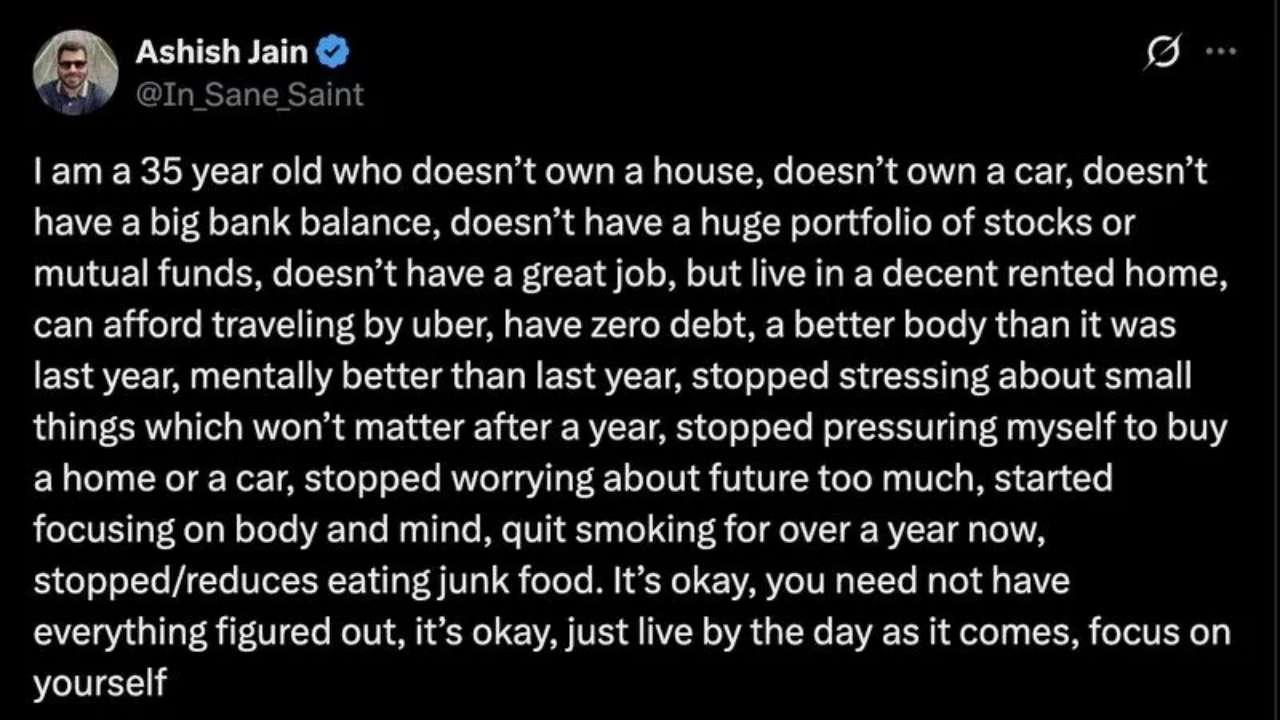
The easy read is that this is India’s version of lying flat—the Chinese phrase for a generation quietly refusing to compete for property, marriage, and status, choosing stillness over the treadmill. It has been called a counterculture, a rebellion, and a low-desire life. It has spread far enough that people here have started asking whether tang ping India is a real, arriving phenomenon or just a convenient label borrowed for something quieter and more local.
I don’t think that’s quite what this is, and the distinction matters more than it looks like it does.
Lying flat, in its actual, documented form, is a refusal. It says, “I see the race, I understand what winning would require, and I am choosing not to run it.” The posture is defiant even when it looks passive. It is built on a clear-eyed rejection of something fully understood.
What the 35-year-old described is different and quieter than a refusal. He never described a race he saw and declined. He described a life he is already living and reported, honestly by every appearance, that it feels fine. There’s no defiance in his words at all, no mention of a system he’s rejecting, no anger at the housing market or the promotion track. Just an inventory of absences, followed by a report of genuine, current well-being.
That’s not lying flat. Lying flat requires having stood up first, seen the room, and decided to sit back down. This is something that hasn’t been tested against the alternative at all, because the alternative was never actually on the table.
Why “Lying Flat” Doesn’t Quite Fit What He’s Describing
Here is the asymmetry I keep turning over, because I think it’s the actual subject of this essay, more than the tweet itself.
Every version of this question I’ve sat with in years of this work has involved someone who climbed first. A friend who built fifteen properties and still can’t stop. A man who hit his number and went back to work the following Monday. A woman who drew her exit at 45, tested it against the life she’d actually built, and found the two matched. Whatever they eventually chose, more or enough, carries a kind of proof that the 35-year-old’s post cannot carry yet. They know what more felt like, specifically, in their own hands, and they rejected it or embraced it with real information behind the decision.
He has no equivalent test available to him. He can report, honestly, that he feels fine without the house and the car. What he cannot yet know, what nobody in his position can know, is whether that peace would survive contact with the thing he’s describing an absence of. Untested contentment isn’t fake. It just carries a question mark that tested contentment doesn’t, and the question mark isn’t going away just because the post got eighty-three thousand views telling him it’s wisdom.
I mentor early-stage founders through a program I’ve done for years, and I watched a version of this play out in a young man I’ll call Kabir.
Kabir was twenty-six, running a small, sustainable services business out of a shared office in Pune, and completely sincere every time he said money wasn’t the point for him. He wanted something small he could run well, control fully, and be proud of. He said it the way people say things they’ve genuinely decided, not performed—no defensiveness in it, no need to convince me. I believed him. I still think he meant every word.
Then a modest acquisition offer came in, not life-changing by Silicon Valley standards but real, the kind of number that would have let him buy the flat his parents had been quietly hoping he’d buy, the kind of number he’d have called absurd wealth two years earlier, back when the business was three people and a shared desk.
I watched three weeks of him negotiating with himself in real time, not with the acquirer. He stopped returning calls as quickly. He brought it up unprompted on calls that had nothing to do with it. He asked me, almost sheepishly, whether wanting to at least hear the full offer meant he’d been lying to himself the whole time. He hadn’t been. He just hadn’t been tested yet, and the testing itself was visibly uncomfortable in a way his original, sincere answer had never needed to be.
He didn’t take the deal, in the end. But the version of Kabir who turned it down was visibly different from the version who’d told me, a year earlier, that money wasn’t the point. That first Kabir had never had a real number in front of him. The second one had, and his eventual “no” was worth infinitely more than the first one’s, because it had finally been tested against something real.
I think about that difference constantly when I read something like this week’s post. Kabir’s contentment became provable the moment there was something concrete to refuse. The 35-year-old hasn’t had that moment yet, and there is no way to manufacture one for him. It either arrives on its own or it doesn’t, and until it does, the peace he’s describing is real but still, honestly, unconfirmed, even to himself.
There is a test worth running here, though it is a slightly frightening one, which is probably why almost nobody runs it voluntarily.
If the house, the car, and the fuller portfolio were offered tomorrow, at zero social cost either way—nobody watching, nobody judging the choice in either direction—would you take them?
Notice how carefully that question has to be built to actually work. It can’t be “Would you want more money?” because almost everyone’s honest answer to that is yes, and it tells you nothing — wanting more is nearly universal and mostly irrelevant. It can’t be asked in public either, because a public answer contaminates itself immediately; saying no in front of people who already admire your simplicity is a different act entirely from actually declining in private. The zero-social-cost condition is the whole point. It’s the only version of the question that isn’t also, quietly, another performance.
This is a harder question than it sounds, because it risks an answer nobody wants: yes. And if the honest answer is yes, that doesn’t make the original post dishonest. It means the contentment being described is still, at least in part, an accommodation to circumstance rather than a fully examined choice—which is an entirely human, forgivable place to be, and also a different place than the post’s eighty-three thousand admirers assumed he was standing in.
If the honest answer is no, if he’d genuinely leave the offer on the table with no one watching either way, then something real is happening here, and it deserves to be taken exactly as seriously as it’s being taken online, not because it resembles lying flat, but because it’s rarer and harder than that: peace assembled before proof, holding up anyway.
I don’t know which answer is true for him, and neither, I suspect, does he, not yet, and maybe not for years, since the offer he’d need to actually test it may never arrive at all. That absence of a test is not a flaw in his post. It’s just the honest, unfinished shape of what he’s actually describing, whether the eighty-three thousand people who called it wisdom noticed that or not.
I want to be careful not to make this sound like an argument that the 35-year-old is wrong, or performing, or fooling himself. I don’t think that, and I don’t think it’s my place, or anyone’s, to diagnose a stranger’s post from a screen.
I also want to resist the opposite mistake, which is treating “untested” as a polite word for “lesser.” There is a real, honest case that choosing to opt out of the wealth race before it fully claims you is its own kind of achievement, arguably a harder one than opting out after. Kabir had years of watching other people’s businesses fail and succeed around him before his own test arrived. The 35-year-old may have been building his version of clarity just as deliberately and quietly, without a single dramatic offer ever needing to appear, some people manage to see the race clearly enough, early enough, from the outside, that they never feel compelled to enter it at all. That is not automatically a lesser form of knowing than learning it the hard way, at the finish line, the way Vishal and dozens of others I’ve sat with eventually did.
What I don’t think holds up is calling it lying flat or treating either version, tested or untested, as more virtuous than the other by default. Both are just different distances from the same open question, and the honest thing to do with either one is keep checking, not stop at the first version that sounds peaceful enough to post.
What I think is worth saying plainly is this: peace chosen after you’ve climbed is easier for other people and for yourself to trust, because it comes with a receipt. Peace assembled before you’ve ever had the chance to climb doesn’t come with one yet, and pretending otherwise, either to reassure yourself or to reassure eighty-three thousand strangers, skips over the one honest thing worth sitting with. Not “is this wisdom or self-deception.” Just: Has this actually been tested yet, and if not, am I willing to find out what happens when it is?
Tang ping India is a phrase some commentators have already started reaching for to describe this. If it’s accurate, it will mostly look like this: quiet, undramatic, and closer to acceptance than rebellion in people who never got close enough to the race to need to refuse it. That’s not a lesser version of the Chinese movement. It’s a genuinely different psychological position, and it deserves its own honest name rather than borrowing someone else’s.
Even Your Exhaustion Is Being Watched
Three reels landed in one feed, in one week.
Before I understood what connected them, I only knew they were describing something close to performative vulnerability, though none of the three used that phrase.
One argued, in Hindi, that Indian society rewards looking successful over being okay. The man drowning quietly inside a Mercedes; the eighty-hour job that costs someone their sleep and health earns more respect than a small job that actually makes them happy. Taali ya neend, it said. Applause or sleep. Choose.
Another was quieter. No thesis, no argument, just a confession, written carefully, about an exhaustion that doesn’t lift no matter how much sleep you get. No anger at anyone specific. Just a wish to be somewhere nobody expects anything.
A third made the same case in English — that an entire generation has quietly redefined success from having more to needing less.
Three pieces of content. One message. One week. That stopped being a coincidence somewhere around the second one.
I want to start with the part that took me longer to see than I’d like to admit, because I think it’s the actual essay, not the throat-clearing before it.
That second reel, the quiet one, the tired one, the one with no thesis, is also, by definition, a performance. It was written with care. It was paced for resonance. It landed the way it landed because someone, consciously or not, built it to land.
Which means the exact thing the first reel was criticizing—dikhawa, performing over being—has slipped quietly into the piece that claims to be about opting out of performing altogether.
Even the exhaustion is getting produced now. Even wanting to disappear has become something you write a caption for.
This is what I mean by performative vulnerability. Not fake feeling The tiredness in that second reel may be completely real. Performative vulnerability is what happens when a real feeling gets shaped, timed, and released for an audience before it’s been allowed to simply exist for the person having it.
I watched a version of this happen in person, at Viram, and I think about it more than almost anything else from that particular cohort.
I’ll call her Ira. On our first call, before she’d arrived, she used almost the exact language from that second reel. Tired in a way sleep doesn’t fix. Not angry at anyone. Just wanting a few days where nobody needed anything from her. It was, word for word, one of the more articulate descriptions of exhaustion I’d heard in years of doing this work.
On day two, we gave her exactly what she’d asked for. An entire afternoon, alone, on the property; no schedule, no expectation, nobody watching.
She lasted about forty minutes.
I watched her leave for the trail with a book she never opened. When she came back, her phone was in her hand, not her book. Not because the exhaustion wasn’t real; I don’t doubt for a second that it was. But because real, unwitnessed rest turned out to be an entirely different experience than the idea of rest she’d been describing so precisely on our call. Without anyone to receive the performance of needing space, needing space stopped having shape. It had nowhere to land. Forty minutes in, she told me later, she’d caught herself composing a sentence in her head, something about the mountains, the silence, and finally breathing, for an audience that, in that moment, did not exist and was not going to see it.
She came back early, quieter than before, and admitted — this is the part I think about — that she’d spent most of the forty minutes deciding how she’d describe the afternoon to people back home, rather than actually having the afternoon. The rest she’d been aching for turned out to require an audience she hadn’t realized she needed until the audience was gone.
She’d asked for solitude and instinctively started narrating it before she’d finished living it.
I don’t think Ira is unusual. I think Ira is what happens to almost anyone who has spent long enough being rewarded for how things look that they’ve lost the muscle for an experience that nobody will ever know about.
The first reel’s argument is really about this same muscle, just applied more broadly, and I’ve watched its exact examples play out for twenty-two years from inside corporate HR.
The gym photo before the gym membership itself. The housewarming party before the house is actually settled into. The anniversary post before the relationship itself has been tended to in the ways that don’t photograph well.
I have sat in more performance reviews than I can count where the person visibly straining under an unsustainable workload said nothing because saying it aloud read as weakness, while the person who’d quietly built a sane, sustainable pace got asked, gently and disapprovingly, whether they were ambitious enough. I have watched people take the eighty-hour job specifically because the exhaustion it produced was legible—nameable, complainable-about at dinner, and worn like a badge—while a genuinely peaceful, smaller life got treated by the same room as a story that needed explaining. Are you okay? People would ask about the person who actually was.
I remember one resignation letter, years ago, from a man who had never once complained in three years on my team. Two lines. Thank you for the opportunity. I’ve decided to spend more time with my daughter before she’s no longer a child who wants me around. No exhaustion story. No dramatic exit. He had simply, quietly, decided, and left. In the same quarter, another employee whose burnout had been the subject of at least four separate conversations, three group emails of concern, and one all-hands mention of “protecting our “people”—stayed for another two years, still complaining, still performing the exhaustion for an audience that had by then stopped really listening. I don’t know, to this day, which of them was actually more tired. I only know which one made it visible and which one simply acted on it without asking anyone to watch.
Dikhawa culture India runs on precisely this confusion. It doesn’t just reward success. It rewards the version of success — and lately, I think, the version of struggle — that comes with a built-in audience already positioned to notice it.
None of this starts in adulthood, and the reel that opened this essay was right to point at where it actually begins.
We are taught marks before we are taught meaning. Trophies before contentment. Perform in front of the relatives, sit up straight for the photo, and don’t let them see you cry at the funeral; smile for the group picture even in the year everything fell apart. Log kya kahenge (what will people say) is not a stray anxiety that shows up occasionally in adult life. For a lot of us, it was installed early enough and repeated often enough that it stopped feeling like a rule and started feeling like conscience.
By the time any of us are old enough to decide, on our own, whether a feeling is worth having privately or worth sharing publicly, the machinery for deciding that has usually already been built by other people, for other reasons, years before we noticed it happening. We were never taught to simply be. We were taught, carefully and repeatedly, to be seen. It is not a surprise, given that training, that even the generation now naming its exhaustion out loud is naming it the way it was taught to name everything else—visibly, articulately, and for an audience that is expected to respond.
What Performative Vulnerability Actually Costs the Person Doing It
Here is the part of all three reels that none of them said, and I think it’s the part that matters most.
The person who is winning this particular game is also losing it. The reel got this right. The man in the Mercedes, the woman with the picture-perfect anniversary post over a marriage that’s quietly dying—they are not exempt from emptiness. If anything, they are further from resolving it, because the applause keeps arriving on schedule, telling them the performance is working, even while the thing underneath it goes on unaddressed.
What none of the three reels named is that the exhaustion post can do the exact same thing. It can become its own small, sad Mercedes—a place to receive real comfort, real comments, and real evidence that you are seen and understood, which quietly makes it a little bit less urgent to change the actual life producing the exhaustion. The relief of being witnessed in your tiredness is real. It is also, if you’re honest, sometimes enough relief to make you stop looking for the harder, quieter, unwitnessed relief that would have actually addressed the tiredness itself.
I don’t say this to make anyone’s exhaustion suspect. Most of it is completely real, including Ira’s, including whoever wrote that second reel. I say it because “real” and “performed” are not opposites. They can be true of the exact same feeling at the exact same time, and learning to tell which parts of your own experience are which might be the most useful, least comfortable thing you ever do for yourself.
So here is the test I’d actually offer, since the reel that started this ended with one too.
Not “are you tired.” Almost everyone reading this is tired. Not even “is it real.” It’s real. That was never the question.
The question is this: would you still want the rest, the quiet, and the disappearing if you were completely certain nobody would ever find out you’d taken them? No caption, no story, no one asking if you’re okay, no comment thread offering you comfort for having said the brave, tired thing out loud. Just you and the actual hours, unwitnessed forever.
If the answer is yes — if the wanting survives completely intact once you remove every single person who might have seen it — then what you have is not performance. It’s the real thing, and it deserves to be protected exactly as fiercely as Ira’s exhaustion deserved protecting, even though she couldn’t yet give it to herself.
If the answer gets quieter, if some of the wanting seems to evaporate the moment nobody would ever know, that’s not a character flaw. It’s just information. It means part of what you’ve been calling rest was actually still a performance of rest, aimed at an audience you didn’t fully realize you were still performing for.
Taali ya neend. The reel that started all this got the choice exactly right. I’d only add, “Check honestly which one you’re actually choosing before you assume the answer.”
Most people never run this test on themselves, not because they’re shallow, but because nobody ever taught them how, and because the answer, when it’s honest, is sometimes uncomfortable enough that it’s easier not to look. Dikhawa culture India doesn’t reward the people who look, only the people who perform having already looked.
This is, plainly, the work I do. Not therapy, not a wellness retreat, not another feed to perform tiredness into. A structured, private space, built specifically as an antidote to performative vulnerability rather than another outlet for it—the kind Ira eventually found on day three, once the performance had nowhere left to go and the actual feeling finally had room to exist—where the only audience for what you’re carrying is you and, briefly, someone whose entire job is to ask the harder version of the question you’ve been asking yourself in captions.
If any part of this essay landed somewhere you didn’t expect it to—if you noticed yourself checking, honestly, which parts of your own tiredness are real and which parts are waiting for someone to notice—the Clarity Call is free, thirty minutes, no pitch, and nobody will ever know you booked it except you. That, it turns out, is usually the entire point.
Needing Less Isn’t Wisdom. Unless You Chose It.
A reel crossed my feed this week making a claim I’ve been watching happen for years; I’ve just never heard it framed this precisely.
Success used to mean having more. For a lot of people now, it means needing less.
What she was describing, without using the phrase, is what’s now being called “quiet ambition,” and quiet ambition splits cleanly into two very different things, depending on how someone actually got there.
The woman making the argument was honest about where her own thinking ran out. Every conversation with people her age sounds the same now, she said. I just want a job that doesn’t make me miserable. I want to sleep properly. I want time with my friends and with my parents. I want enough money to not be stressed. That’s it.
She didn’t call this laziness. She called it fifteen years of watching the goalposts move—study hard, get the grades, get into the good college, get the good job, get the promotion, and then what? The housing prices are insane. The promotion made you more stressed, not less. Maybe millennials are the first generation to realize there is no finish line, she said.
Then she stopped, honestly, at the hardest part.
“Maybe that’s wisdom,” she said. Or maybe we’re all just worn out. I genuinely don’t know.
I think I do know. Because I’ve sat across from both versions of the person she’s describing, and from the outside they are almost impossible to tell apart.
Both of them will tell you, in nearly identical words, that they’ve stopped chasing. Both will describe wanting less, needing less, and running less. Both will use the word peace. If you only listened to what they said, you would conclude they’d arrived at the same place by the same road.
They have not.
One of them drew a picture.
Not metaphorically. I mean an actual picture, on an actual page, years before they had the means to live inside it—what a Tuesday would look like, specifically, hour by hour, once the running stopped. Who they’d be with. What work, if any, they’d still choose to do. What the quiet actually felt like, in detail, not as an abstraction. When the running did eventually stop, for this person, the picture and the life matched. Not approximately. Precisely, the way a plan matches an outcome when the plan was real.
This person’s “needing less” is not a retreat. It is possibly the single most deliberate decision they have ever made, dressed in language so quiet it sounds like giving up.
The other person never drew anything.
They simply got tired enough, for long enough, that wanting less started to feel like the only sane thing left to want. There was no picture. There was no Tuesday they could describe to you in detail, because they’d never sat still long enough to build one. What they have instead is relief: the specific, real, and completely legitimate relief of a nervous system that has finally been allowed to stop bracing. That relief is not nothing. But it is not the same thing as clarity, and mistaking one for the other is exactly how a person ends up, eighteen months later, unexpectedly restless inside a life they swore would finally be peaceful.
The reason these two people sound identical is that the vocabulary of “enough” is genuinely the only vocabulary either of them has access to. Our culture gave both of them the same handful of phrases—balance, boundaries, peace, and enough—and neither the language nor the culture much cares which foundation those words are sitting on. A sentence like “I just want to sleep properly” can be the exhausted end of fifteen years of chasing goalposts, or it can be the calm, specific request of someone who has already built the life where that sentence is simply and literally true. English doesn’t have two different words for those. Neither, as it turns out, does a viral reel with ninety seconds to make its point.
I don’t think this is a millennial problem, particularly, though the reel is right that this generation is unusually loud about naming it. Quiet ambition, real or performed, has probably existed in every generation. This one just says it out loud, on camera, at scale. I think it’s the oldest confusion there is, wearing a very current outfit. Every generation has produced people who called their exhaustion “wisdom” because “wisdom” sounded better, and calling it that made the exhaustion easier to bear. What’s new, maybe, is that an entire cohort is now saying the quiet part out loud, together, at scale, on camera, which makes the confusion easier to see if you’re willing to actually look at it instead of just nodding along because the sentiment feels true.
How to Tell If Your Quiet Ambition Is Real
Here is the test I actually use, with the people who sit across from me making some version of this exact claim.
I ask what a completely free Tuesday looks like. Not the fantasy version — nobody has trouble describing a fantasy. The real one. Where are you? What time did you wake up? What’s the first thing you do that isn’t checking a phone? Who’s around? What, if anything, are you working on, and why that thing specifically?
The people who have actually chosen quiet ambition answer this within seconds, in specific, almost boring detail. They’ve lived inside the answer already, in their heads, hundreds of times, long before they arrived at it in fact. The picture doesn’t need to be invented under pressure. It was already there.
The people who are tired, not wise, go quiet in a different way than the reel’s narrator went quiet. They start reaching for the same abstractions again — peace, balance, less stress — because underneath the abstractions there’s nothing yet. Not because they’re shallow. Because nobody ever asked them to build anything more specific than a feeling to run toward, and a feeling, unlike a Tuesday, doesn’t have any hours in it you can actually check your life against.
This is not their fault. Almost nobody teaches this distinction. We teach ambition in exhaustive detail—the degrees, the ladders, the goalposts, and the reel names so precisely. We teach almost nothing about how to want less on purpose, with the same rigor we were taught to want more.
I want to be careful here, because there’s a version of this essay that turns into telling tired people they haven’t earned their rest until they’ve done more homework first, and that is not what I mean.
Rest is not conditional on having a five-year plan for what comes after it. If you are exhausted, you are allowed to stop, full stop, with no picture required and no test passed first. The distinction I’m making isn’t about who deserves to rest. It’s about what happens after the resting starts to feel normal again, which for most people, eventually, it does.
That’s usually when the second, quieter question shows up, the one the reel’s narrator hasn’t reached yet. Not “am I tired?” Tired resolves, given enough time and enough actual rest. The second question is “What do I actually want now that I’m not too depleted to want anything?” and that one does not resolve on its own. It has to be built, the same slow, deliberate way ambition used to be built, just pointed in a different direction.
Some people build it. Their version of needing less turns out to be exactly as considered, as chosen, and as durable as any five-year career plan ever was—just quieter and aimed at something that doesn’t show up on a resume.
Other people never build it, because the relief of stopping felt so much like an answer that they mistook it for one. They call it peace for a while. Then, often around the point everyone around them stops asking if they’re okay, the old restlessness comes back wearing a new question: Is this actually what I wanted, or is this just where I stopped running?
The culture is finally catching up to something worth saying carefully about quiet ambition instead of just quoting it.
Needing less isn’t automatically wiser than wanting more. It’s only wiser when someone actually chooses it, with open eyes, specific enough to describe an ordinary Tuesday inside it—rather than arriving there because everything else simply got too heavy to keep carrying and staying there because nobody ever asked them the second question.
If you’re not sure yet which one is true for you, that’s not a failure. It’s just information. It means the picture hasn’t been drawn yet, not that something is wrong with you for still wanting to know.
If this stayed with you, the clarity call is free and takes thirty minutes. No pitch. Most people leave it finally able to describe their Tuesday.
He Built a Case for Staying. He Already Wanted to Leave.
Most NRI return to India decisions get argued out on a spreadsheet. This one gave itself away in a single paragraph instead.
A post crossed my feed a few weeks ago. An anonymous handle, a forum for people planning early retirement, the kind of place where net worth gets typed out like a resume.
I do not know this man. I will call him R. But I have sat across from a dozen versions of him in Dehradun, so the words could have come from any of them.
Here is roughly what he wrote.
He and his wife live in California. Forty-two and forty, one son, ten years old. They can retire now, in India, at a level of wealth that would be considered fat in any city in the country. Or they can wait eight more years, keep working in the Bay Area, and retire there instead, at a number that is objectively larger in dollar terms.
He wrote that he has “a quiet ache for home.” He asked how other people in his position make the decision. What is the thought process? How do you let go?
Then, a few lines later, without seeming to notice he had done it, he answered his own question.
He wrote that human migration is normal. That moving is not leaving your roots behind; it is spreading them. That Europeans, when they ran out of space, spread themselves to new worlds, and future generations enjoyed what they built. He told himself he should not feel guilty. Future generations, he said, will enjoy the space they have here.
I read that paragraph three times.
The question that was already answered
R. thinks he is asking a financial question. Forty crore now versus four million dollars in eight years, both numbers in a very high cost of living area, and both numbers are comfortable by any measure. He is asking the forum to help him do the math.
But nobody builds a defense for a decision they haven’t made.
You do not construct an argument about the nobility of migration, complete with a historical precedent about Europeans settling new continents, if you are genuinely deciding between two acceptable outcomes. You construct that argument because some part of you has already chosen, and the rest of you needs permission to admit it.
I have watched this pattern enough times to recognize it instantly. It rarely announces itself as indecision. It shows up as research. As a spreadsheet with one more column added. As a forum post asking strangers for a “thought process,” when the real question is much smaller and much harder: Is it acceptable for me to want what I already want?
R. wants to go home. He said so in the first sentence. Everything after that first sentence is scaffolding, built to hold up a decision that does not actually need defending, only permission.
Why the defense had to be so elaborate
I want to be fair to him, because I understand exactly why the case had to be this big.
He is not choosing between two neutral options. He is choosing to walk away from a number that keeps growing, in a system that has told him, at every stage of his career, that the correct move is always the one that produces a bigger number. Silicon Valley does not have a category for “enough.” It has levels, refresh cycles, and the next vest date. A person who has spent years inside that machine does not leave it quietly. They leave it with an argument prepared, because some part of their nervous system still expects to be cross-examined.
So the argument becomes big. It becomes historical. It reaches all the way back to European settlers, because a decision that only concerns one family’s happiness apparently is not weighty enough to justify walking away from a fatter number. It needs the added gravity of destiny, of generations, of an old and larger story that has nothing to do with a ten-year-old boy who misses his grandparents.
This is what guilt does when it is unspoken. It does not stay small. It recruits history to make its case.
I do not think R. is unusually anxious or unusually indecisive. This is what an NRI return to India decision looks like for a lot of high-earning professionals who grew up in a culture that ties self-worth tightly to output. He has internalized, probably without ever choosing to, that wanting to go home for reasons that are simply emotional is not a strong enough reason. So the ache becomes a thesis. The homesickness becomes an essay about migration patterns.
What eight years actually costs
Here is the part of the calculation that a spreadsheet cannot hold and that I think matters more than either number he is comparing.
His son is ten.
In eight years, his son will be eighteen. Not a child who wants his father around for the texture of ordinary days—school pickups, weekend cricket, and the visits to grandparents that only happen because the flight is short instead of impossible—but a young adult with his own life already largely formed, likely already gone to college, and likely already living somewhere his parents did not choose for him.
The eight-year wait is not neutral time. FIRE forums tend to talk about compounding as though it only runs in one direction—the portfolio grows, the withdrawal rate improves, and the safety margin widens. Nobody puts a number on what compounds on the other side of the ledger. A grandparent gets eight fewer years with a grandchild who is currently small enough to remember him clearly. A father gets eight fewer years of being the parent his son runs to first, before adolescence quietly redirects that toward friends and independence, the way it does for every child everywhere.
I am not saying the money does not matter. It does. Four million dollars is real security, and it is not something to dismiss glibly from the comfort of a Dehradun garden. But I want to be precise about what is actually being traded here, because “wait eight years for a better number” sounds prudent right up until you say the other side of the trade out loud: eight years of a specific, unrepeatable window in a child’s life, spent in a city his father already describes, unprompted, as something he has “an ache” to leave.
The portfolio can wait. It has no memory and no clock of its own. The ten-year-old does not have that luxury. Childhood is the one asset class that does not compound. It only spends down, on a schedule nobody controls.
Guilt is not evidence
I want to say something directly to R., or to whoever reads this and recognizes the shape of their own reasoning in it.
The guilt you are trying to argue your way out of is not evidence that the decision is wrong. It is evidence that you were raised inside a framework where “I want this because it will make me and my family happier” was never treated as a complete sentence. Somewhere along the way, wanting something for its own sake started to feel insufficient. It needed a justification that carried more weight—a historical parallel. A moral defense.
But happiness does not require a defense. Missing your parents does not require a citation. A father wanting more ordinary Tuesdays with his son before adolescence closes that particular door does not need to be reframed as a grand narrative about the spread of civilizations.
It is allowed to simply be true and reason enough on its own.
I have sat with people in the middle of exactly this kind of reasoning, at Viram and in Clarity Calls, and the moment that actually changes something is rarely a better spreadsheet. It is the moment someone says the true sentence out loud without the scaffolding around it. Not “migration is a natural human pattern, and I should not feel guilty,” but simply, “I miss home, and I am tired of telling myself the ache is not a good enough reason.”
The second sentence is smaller. It is also the only one that is actually true.
Why NRI Return to India Decisions Never Resolve at the Number
I do not know if R. and his family will move. That is not mine to decide, and it should not be decided by a forum of strangers doing FatFire math either, however well-intentioned the replies.
But I would gently suggest that the four-million-dollar number, when it eventually arrives in eight years, will not settle anything, because it was never the actual obstacle. The obstacle was permission. And permission does not compound. It does not require a bigger number to arrive. It is available right now, the same way it was available the day he first felt the ache, long before he opened a spreadsheet to argue himself out of it.
The FIRE community is very good at optimizing the number. It is much less equipped to answer the only question that was ever really on the table: What do you actually want, once you stop needing to justify it to anyone, including yourself?
R. already answered that question in the first sentence of his own post. Everything he wrote after it was an attempt to talk himself out of trusting the answer.
If this essay resonated—if you are somewhere in your own NRI reverse migration India timeline and recognize the shape of building a case for something you have already decided—the Clarity Call is a free, thirty-minute conversation. No pitch. Most people leave it, having said, out loud, the smaller and truer sentence they had been arguing around.